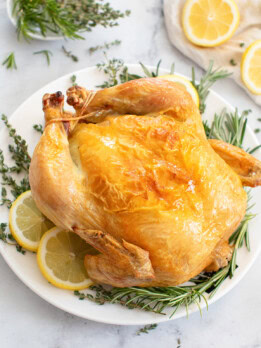
2 Ingredient Crispy Roast Chicken
You’re never going to believe you only need two ingredients to make the perfect, juiciest chicken. No oil or butter is required to get a crispy, crackly skin. We combine Thomas Keller's famous roast chicken technique and add a dry brine and a little science called osmosis. The chicken is generously salted and then sits overnight in the fridge. The salt draws out moisture and then gets reabsorbed into the meat to make it tender and flavorful. As it cooks, the natural fat from the skin will make it super crispy and crunchy. This dish is truly a show stopper and will be an amazing addition to your weekly dinner rotation!
Ingredients
- 4 lb (1814 g) whole chicken, preferably organic, see note regarding size
- 1- 1 1/2 tbsp (12 g- 18 g) kosher salt, see note on amount of salt to use
Instructions
- Remove innards and giblets from inside the chicken. Pat completely dry with paper towels (on both the outside and in the cavity) and place in a large roasting pan with a wire rack.
- Generously sprinkle the salt on both the inside and and outside of the chicken, including the underside. I use about 1 tbsp but you can use 1.5 tbsp if you prefer your chicken to be more seasoned (see note for more details).
- Put the chicken in the fridge, uncovered, for about 8 hours or overnight. I put it in with the roasting pan so that the roasting pan catches any drippings. See note section on why we recommend this extra step instead of cooking the chicken right away.
- When you are ready to cook the chicken, preheat the oven to 450°F (232°C).
- Let chicken come to room temperature for about 30 minutes before you are ready to cook it. Truss the chicken with kitchen twine. First make a figure 8 with the twine to tie the drumsticks together. Then run the twine to the front of the chicken, tucking the wings into the twine and tying a knot at the front of the chicken. Cut the ends of the twine after you have tied a knot. See video on how to truss the chicken.
- Put the chicken in the preheated oven (in the roasting pan and sitting on the wire rack) and let it cook for about 50-60 minutes or until the internal temperature of the thigh reaches 165°F and the skin is golden brown and crispy. How long the chicken needs to cook will depend on the size of your chicken. Check the chicken halfway through and rotate the pan if one side is getting darker than the other. Let cool slightly before carving.
Notes
- Chicken size: We found that this recipe works best with a 4lb chicken or smaller. A 4 lb chicken will cook in about an hour. Anything larger will need more time which causes the top of the skin to get a bit darker. The largest size chicken to use for this recipe would be 5 lb (but know that your skin won't be golden brown everywhere and will likely be darker brown).
- We recommend using organic chicken for best flavor.
- Salt: In Thomas Keller's original recipe, he very generously salts the chicken and describes it as raining salt on the chicken and adding enough salt that you can still make out the salt on the crispy skin. While this amount of salt is fine, I prefer using less salt when cooking at home to help balance out the amount of salt we eat when we do dine at restaurants. I use about 1 tbsp of salt and found this was still enough to crisp up the skin, keep the chicken moist and season the chicken. So you can add anywhere between 1 and 1.5 tablespoons, depending on your preference. It will also depend a little on the size of your chicken. The 1.5 tbsp in the chicken is for a 4-5 lb chicken.
- Dry brine/Refrigeration: While you can cook the chicken right away, we found that the extra step of the dry brine really makes a difference. This process is explained more in the post section, but the salt is given time to absorb moisture from the skin, allowing the skin to really crisp up. The salt is also reabsorbed back into the chicken which gives the chicken more flavor and makes it very tender.
- Part of this recipe is adapted from Thomas Keller's Simple Roast Chicken from his Bouchon cookbook
Serving: 1serving, Calories: 233kcal, Protein: 35g, Fat: 28g, Saturated Fat: 8g, Sodium: 908mg
The nutrition information provided are only estimates based on an online nutritional calculator. This is not a comprehensive list of all the nutrients in the recipe (i.e., does not include vitamins, cholesterol, etc). I am not a certified nutritionist. Please consult a nutritionist or doctor for accurate information and any dietary restrictions and concerns you may have.
Did you make this recipe?Please leave a star rating and review below!