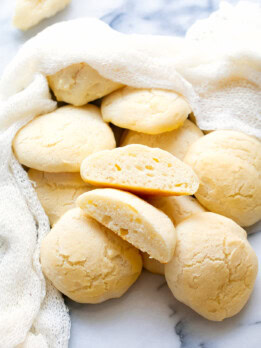
3 Ingredient Buttery Bread Rolls
These easy bread rolls come out buttery, soft and chewy. They don't require any yeast, kneading, eggs or sugar.
Ingredients
- 2 cups (250 g) self-rising flour, see note regarding amount needed
- 1 cup (8 oz) milk, or milk alternatives
- 2 tbsp (28 g) butter, melted
Instructions
- Preheat oven to 350°F. Line a baking sheet with parchment paper.
- In a large mixing bowl, combine flour and milk. Use a spatula to stir until no flour chunks remain. You may need to press your spatula down on flour chunks to break up the flour. Your mixture should be a thick liquid. Let the mixture sit for 5 minutes. During this time you should see the mixture rise slightly and thicken.
- Use a cookie scoop (or ice cream scoop with release lever) to scoop out dough balls, placing them on your prepared baking sheet, spaced 2 inches apart. I was able to get 10 dough balls. I used a 1.5 tbsp cookie scoop but I heaped the amount in each scoop so that it was more than what the scoop holds. It's okay if the bread dough spreads out a little after they are placed onto the baking sheet. This is normal as these breads will not be as tall as typical bread rolls.
- Brush surfaces of bread generously with melted butter. Bake bread rolls for about 23 minutes or until done. Your finished breads will not change much in color. They will be stay pale but the bottoms should be a golden brown.
Notes
- This recipe was originally tested with White Lily self-rising flour which has a lower protein amount than some other brands of self-rising flour. The amount of protein affects the amount of liquids needed. If you are using a self-rising flour that has 2 grams of protein per 1/4 cup, then you can make the recipe as written.
- If you are using a self-rising flour brand that has 3 grams of protein per 1/4 cup, then remove 4 tbsp of flour from the amount stated in the recipe and replace with 4 tbsp of cornstarch.
- To properly measure flour, spoon the flour into the measuring cup and then level off with a knife. Do not directly dip the measuring cup into the flour because this results in too much flour. Use this method of measuring whether you are measuring self-rising flour or measuring all purpose flour to make your own self-rising flour.
- Homemade self-rising flour:
- If you are using all purpose flour with 2 grams of protein per 1/4 cup: Whisk together 2 cups all purpose flour + 3 tsp baking powder + 1/2 tsp salt.
- If you are using all purpose flour with 3 grams of protein per 1/4 cup: Whisk together 1 cup + 12 tbsp all purpose flour + 4 tbsp cornstarch + 3 tsp baking powder + 1/2 tsp salt.
- The dough will be very sticky and wetter than typical bread dough. The easiest way to scoop it is with a cookie scoop since it has a release lever to release the dough directly onto the baking sheet.
- I used low-fat milk but the recipe will also work with whole milk. You can also use milk alternatives like soy, almond, coconut or oat milk.
- I don't recommend leaving out the butter. The butter not only adds flavor to the bread, but it adds fat to the recipe, which keeps the tops of the breads from being too dry.
- I have not tested this recipe with gluten-free flour or whole wheat flour.
- I used White Lily Self Rising Flour.*
- *This product link is an affiliate link. This means I earn a small commission from qualifying purchases.
Serving: 1roll, Calories: 110kcal, Carbohydrates: 19g, Protein: 2g, Fat: 3g, Saturated Fat: 2g, Sodium: 310mg, Sugar: 1g, NET CARBS: 19
The nutrition information provided are only estimates based on an online nutritional calculator. This is not a comprehensive list of all the nutrients in the recipe (i.e., does not include vitamins, cholesterol, etc). I am not a certified nutritionist. Please consult a nutritionist or doctor for accurate information and any dietary restrictions and concerns you may have.
Did you make this recipe?Please leave a star rating and review below!