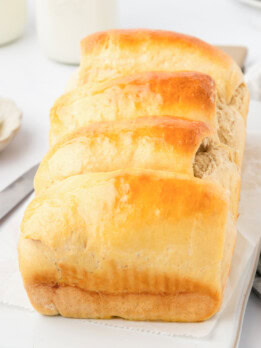
3 Ingredient Milk Bread
This 3-Ingredient Milk Bread is a delightful and simple take on traditional Japanese milk bread. With just self-rising flour, honey Greek yogurt and egg, you can create a soft and fluffy loaf. The result is a beautifully golden loaf with a tender crumb, ideal for sandwiches or enjoying on its own.
Ingredients
- 4 cups (520 g) self rising flour, see note before starting
- 1 1/3 cups (324 g) honey Greek yogurt, see note before starting
- 2 large eggs, divided
Instructions
- Grease a 9 x 5 inch loaf pan. Add one of the eggs to a small bowl and whisk until beaten. Measure out 1 tbsp of whisked egg and add it to a bowl of a stand mixer. Save the remaining whisked egg for egg wash to be used later.
- Add in flour, yogurt and the remaining egg (the nonwhisked one) into the bowl of the stand mixer that already has the 1 tbsp of whisked egg.
- Using the dough hook attachment, mix ingredients on low speed until the dough starts to come together, about 1 to 2 minutes. Increase the speed to medium (between 2-4 on stand mixer) and continue to knead until the dough is smooth, elastic and is no longer sticking to the bowl, about 2-3 minutes. If you knead the dough too long it will actually become sticky again. If this happens, add a little bit more flour (abou 1-3 tbsp) and only knead on low speed until the flour is incorporated and the dough is no longer sticky again.
- Transfer dough to a lightly floured surface (I used self-rising flour on the surface). If your dough isn't too sticky to roll out without any flour, you can skip flouring your surface. Divide the dough into 4 equal portions. (I recommend using a scale to weigh the dough to make sure the portions are equal.)
- Roll out each portion into a rough 11 x 4.5-inch rectangle. Brush off any excess flour. Then starting with one short side, tightly roll up dough jelly-roll style, into a cylinder. Any excess flour is going to make the dough dry and cause the tops of the bread to crack so try your best to use as little extra flour as possible when rolling out the dough and brush off any excess. Place the bread rolls into the greased loaf pan, seam side down. See photos in post for reference. Cover the pan with a towel and let it rest for 30 minutes to let the gluten relax. The bread will not rise during this time.
- Preheat the oven to 350°F (175°C). Place a large roasting pan in the bottom rack of the oven. While your oven is preheating, fill a large pot with water on the stove and bring it to a boil.
- Right before the oven is ready, brush the tops of the bread with remaining whisked egg.
- When oven is ready, carefully pour boiling water into the roasting pan in the oven. Then add the bread on the rack above and bake for about 30-40 minutes or until dark golden brown and cooked through.
Notes
- Self-rising flour amount. There are 2 main kinds of self-rising flour sold in the US. One that is a lower protein (2 grams per 1/4 cup (30g)) flour and one that has a regular amount of protein (3 grams per 1/4 cup (30 g)). Brands like King Arthur Flour and White Lily make the low protein flour. Brands like Gold Medal* and most store/generic brands contain a regular protein amount. The amount of protein affects how much liquid is absorbed. For this recipe, you want a flour with a regular amount of protein. Please use a self-rising flour with 3 grams of protein per 1/4 cup (30 g). Or make your own self-rising flour with the recipe below.
- *This product link is an affiliate link. This means I earn a commission from qualifying purchases.
- Homemade self-rising flour: Combine 4 cups of all purpose flour, 2 tbsp baking powder and 1 tsp salt. Whisk to evenly combine. Make sure your all purpose flour has a regular amount of protein (3 grams per 1/4 cup). Most brands in the US contain this amount but there are some brands with higher protein (4 grams per 1/4 cup) such as King Arthur Flour and Bob's Red Mill. You do not want a high protein flour for this bread. It will be dense and dry.
- Honey Greek Yogurt: You want to use a sweetened Greek yogurt with a low amount of protein. We recommend Greek Gods Honey Greek yogurt. Honey flavored Greek yogurt adds a little sweetness to the bread and also honey flavored Greek yogurt has less protein than plain Greek yogurt. We found that Greek Gods brand has a particularly low amount of protein (7 grams per 170 g serving) which makes it ideal for this recipe. We did test the bread with a Greek yogurt with a little higher amount of protein (15 g per 170 g serving) and while it still worked, the bread doesn't rise as much and is a little more dense. We don't recommend other flavors of Greek yogurt only because then the bread will have that flavor as well. For example, the recipe works with a vanilla Greek yogurt but then the bread has an unusual vanilla taste to it.
- You do need to make sure you use Greek yogurt and not regular yogurt. We tested regular yogurt, even thick regular yogurt like French yogurt, and the bread was gummy and dense.
- You do need to add the egg. The egg makes the bread dough softer, richer and more elastic. Don't substitute with butter or oil. That will make the bread more flaky like a biscuit.
- It's okay if some of the sections on the bread crack on top. Mine will usually have 1-3 cracks though sometimes I don't have any cracks. It depends on how much flour I used and the yogurt.
- This bread uses a more simplified jelly-roll process compared to the rolling technique of traditional milk bread. We did test with the traditional technique but it didn't work as well because the bread doesn't rise as much. We also did test using a water roux but it did not help the bread develop a better texture.
Serving: 1slice, Calories: 174kcal, Carbohydrates: 33g, Protein: 6g, Fat: 2g, Saturated Fat: 1g, Sodium: 492mg, Sugar: 4g, NET CARBS: 33
The nutrition information provided are only estimates based on an online nutritional calculator. This is not a comprehensive list of all the nutrients in the recipe (i.e., does not include vitamins, cholesterol, etc). I am not a certified nutritionist. Please consult a nutritionist or doctor for accurate information and any dietary restrictions and concerns you may have.
Did you make this recipe?Please leave a star rating and review below!