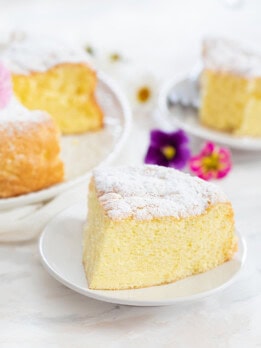
3 Ingredient Sponge Cake
This sponge cake is so light, fluffy and airy. It is just 3 ingredients and doesn't require any butter or oil.
Ingredients
- 4 large eggs, separated
- 6 tbsp (72 g) granulated white sugar
- 5 tbsp (41 g) all purpose flour
Instructions
- Preheat oven to 350°F (177°C). Grease only the bottom of a 7 inch round nonstick springform pan. Line the bottom with a parchment paper round. Do not grease the sides of the pan.
- Add egg yolks and half of the sugar (3 tbsp/36 g) to a large mixing bowl. Whisk until sugar is fully dissolved into the egg yolks. Make sure you do this first and do not add the flour in until the egg yolks and sugar are mixed together. If you try to add the flour with the egg yolks, you'll get a crumbly dough and your batter will not turn out. Once the egg yolks and sugar are mixed, add in the flour (see notes on measuring the flour) and whisk until batter is smooth. The batter will be quite thick.
- Add egg whites and remaining sugar to a mixing bowl. Beat with an electric mixer on highest speed until stiff peaks form.
- Add in 1/3 of the egg white mixture to the egg yolk batter. Fold it gently in with a spatula, making sure to always start folding from the bottom of the bowl to the top. Fold in gently until no egg white streaks remain. Repeat with the next 1/3 of the batter and then the final 1/3. Your batter should look very light and airy.
- Pour the batter into the prepared pan. Rap the bottom of the pan 3-5 times against the counter to remove any air pockets.
- Place pan into the oven to bake. Bake cake for about 23 minutes or until done. Be careful not to overbake the cake. When the cake is done, the surface should be puffed up and evenly browned on top. Once the cake is removed from the oven, it will deflate a little. Let cake cool for at least several hours or overnight before serving. Use a thin spatula or similar tool to completely loosen the cake from the sides of the pan. Make sure you do this before you release the springform ring, otherwise your cake will stick to the ring and break when you release it. You can serve the cake plain or dust with powdered sugar before serving.
Notes
- This is an Asian style sponge cake. If you are unfamiliar with this kind of cake, it is lighter and more delicate than some other types of sponge cakes and is not super sweet. When it first comes out of the oven it does have a little bit of an eggy smell. This goes away by the next day which is why I recommend serving it the following day if you are serving it on its own. If you are making it as a layered cake, the frosting and filling will overpower any slight egginess.
- Make sure you do not add too much flour. This is very important for this batter because this batter has very little liquid and if you add too much flour, your batter will be too thick and dry and will not mix with the egg whites. If you are using a measuring spoon, level off the top with a knife. If you are using a measuring cup, spoon the flour into the cup and then level off with a knife.
- Make sure you add half of the sugar to the egg yolks. The sugar adds moisture to the batter and without the sugar, your batter will be too dry.
- Do not grease the sides of the pan. The cake needs to stick to the sides to keep it from collapsing along the sides as it deflates. By leaving the sides ungreased, it allows the sides of the cake to stay up so that the cake only deflates slightly on top.
- I used a springform pan. You can use a regular pan but make sure it is nonstick, otherwise it will be hard to remove the cake from the sides of the pan.
- If you wish to make a layered cake, you can slice the cake in half horizontally for a two or three layered cake (though the layers will be very thin for 3-layers). Or you can bake a second cake for three fuller layers.
- When slicing the cake for serving, I recommend using a large sharp knife and gently running it back and forth instead of forcing it all the way down. Because of how delicate the sponge is, if you simply push down on the knife, it will squish the cake. Instead, cut into the cake like you are slicing bread (back and forth motion).
- This recipe uses standard large US eggs. You should have approximately 69 g egg yolks and 122 g egg whites.
- This cake is often made with cake flour. You can use cake flour. I made it with all purpose because I know cake flour is not a common pantry staple. I found the differences to be very slight. If serving on its own, I prefer the all purpose flour version. If making a layered cake I prefer cake flour because the cake flour one is slightly fluffier and also doesn't deflate as much. However the cake flour version is also slightly eggier.
- I used this 7 inch springform pan.*
- *This product link is an affiliate link. This means I earn a commission from qualifying purchases.
Serving: 1slice, Calories: 87kcal, Carbohydrates: 13g, Protein: 4g, Fat: 2g, Saturated Fat: 1g, Sodium: 36mg, Fiber: 0.1g, Sugar: 9g, NET CARBS: 13
The nutrition information provided are only estimates based on an online nutritional calculator. This is not a comprehensive list of all the nutrients in the recipe (i.e., does not include vitamins, cholesterol, etc). I am not a certified nutritionist. Please consult a nutritionist or doctor for accurate information and any dietary restrictions and concerns you may have.
Did you make this recipe?Please leave a star rating and review below!