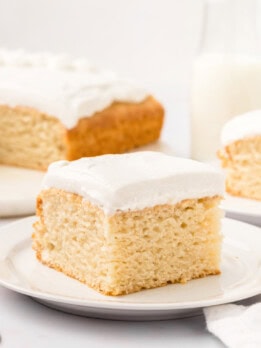
4 Ingredient Vanilla Cake
This vanilla cake is soft, moist and has a texture like regular cake even though it is egg-free, dairy-free, and doesn't contain butter or oil. The cake is easy to make and needs just 4 ingredients to make it.
Ingredients
- 1 tbsp (0.5 fl oz/15 ml) vanilla extract, or vanilla bean paste
- 1 1/2 cups (300 g) granulated white sugar
- 1 (13.6 fl oz/403 ml) can full-fat coconut milk, whisk the contents inside the can so the milk and cream are evenly mixed before measuring and using
- 2 cups (270 g) self-rising flour , see note before starting
Instructions
- Preheat the oven to 350°F (177°C). Grease an 8-inch square pan with non-stick cooking spray and then line with parchment paper, leaving some overhang for easy removal later.
- In a large bowl, whisk together vanilla, sugar and 1 cup of coconut milk until evenly combined. Do not add in the full amount of coconut milk. You will be adding in the remaining later.
- Add the flour. Use a spatula to mix it in until you have a smooth batter. The batter will be very thick but I found that only adding in half of the coconut milk initially will make it much easier to achieve a lump-free batter. Once you have a smooth batter, add in the remaining coconut milk (make sure to use a spatula to scrape the inside of the can to get every bit of coconut milk into the batter) and mix in with your spatula until the additional coconut milk is evenly incorporated.
- Pour the batter into the prepared pan and use an offset spatula to smooth it evenly across.
- Bake for about 60-70 minutes or until the cake is done. Baking time will vary depending on the coconut milk you use. Some brands have more fat than others. When the cake is done it should be lightly golden on the surface and if you apply light pressure to the surface of the cake, it should bounce back.
- Let the cake cool for about 15 minutes in the pan before removing it and placing on a wire rack to finish cooling. Let cake cool fully before cutting or decorating. Store uneaten cake in fridge or freezer.
Notes
- Self-rising flour note: There are 2 main kinds of self-rising flour sold in the US. One that is a lower protein (2 grams per 1/4 cup serving) flour and one that has a regular amount of protein (3 grams per 1/4 cup (30g) serving). The amount of protein affects how much liquid is absorbed. For this recipe, I tested it with Gold Medal self-rising flour* (regular amount of protein). Please use a self-rising flour with a regular amount of protein (3 grams per 1/4 cup), or make your own self-rising flour with the recipe below.
- Homemade self-rising flour: Whisk together 2 cups all purpose flour, 1 tbsp baking powder and 1/2 teaspoon salt. Make sure your all purpose flour has a regular amount of protein (3 grams per 1/4 cup). Most brands in the US contain this amount but there are some brands with higher protein (4 grams per 1/4 cup) such as King Arthur Flour and Bob's Red Mill, which will not work well for this recipe.
- I tested this recipe with Thai Kitchen Organic Coconut Milk.* Make sure to use full fat canned coconut milk for this cake.
- *These product links are affiliate links. This means I earn a commission from qualifying purchases.
- Optional Frosting:
- For this cake, I made a simple vanilla coconut cream frosting. Please note if you want to add piping, you will need to double the frosting recipe.
- 1 (13.66 fl oz) can coconut cream, chilled in fridge overnight (I used Whole Foods Coconut Cream)
- 1/3 cup powdered sugar
- 1.5 tsp vanilla
- To make the frosting, open the can of chilled coconut cream and scoop out only the solid white part. (How much solid white will vary depending on the brand and each can. Sometimes it's mostly or completely white and sometimes you will have some liquid at the bottom). Add the coconut cream, sugar and vanilla to a stand mixer and beat at highest speed until you have a thick whipped cream consistency. If your cream is a little grainy, you may need to add a small amount of the liquid from the can until you have a light and fluffy frosting. Frost the top of the cake with frosting.
- I prefer using powdered sugar in the frosting because it makes the frosting a little thicker but it also works with granular sugar. If you want to thicken the frosting even more, you can add a little cornstarch or gelatin.
Serving: 1slice, Calories: 211kcal, Carbohydrates: 39g, Protein: 2g, Fat: 5g, Saturated Fat: 4g, Sodium: 244mg, Sugar: 25g, NET CARBS: 39
The nutrition information provided are only estimates based on an online nutritional calculator. This is not a comprehensive list of all the nutrients in the recipe (i.e., does not include vitamins, cholesterol, etc). I am not a certified nutritionist. Please consult a nutritionist or doctor for accurate information and any dietary restrictions and concerns you may have.
Did you make this recipe?Please leave a star rating and review below!