

3 Ingredient Cottage Cheese Bread (No Yeast, Eggs, Butter or Oil)
This cottage cheese bread has a texture like bread made with yeast, but doesn’t contain any yeast. It is just 3 ingredients and doesn’t require any yeast, eggs, butter or oil. It also doesn’t require any kneading. The bread is crusty on the outside and soft on the inside.
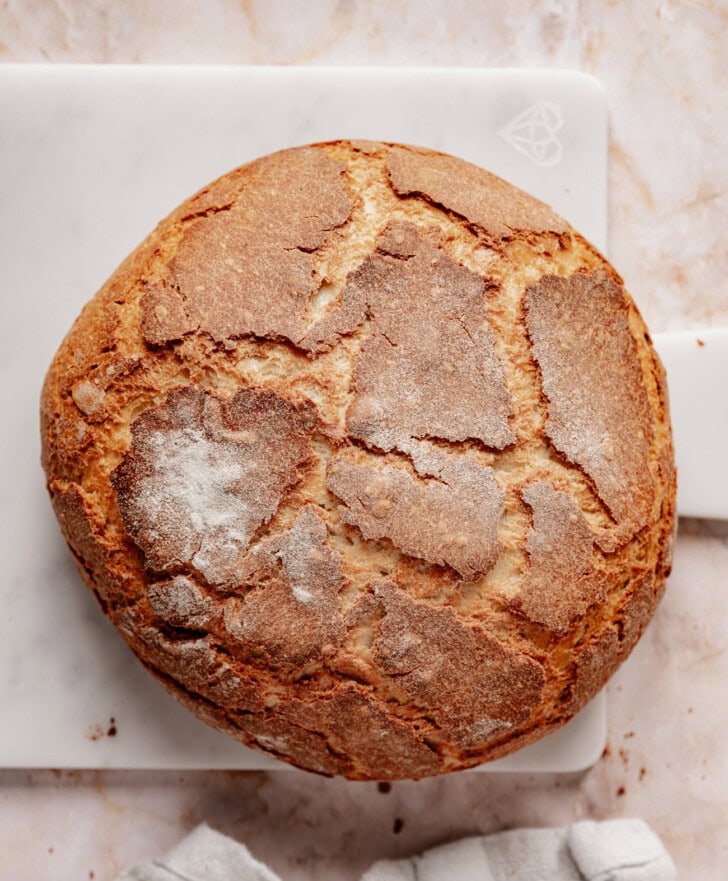
This cottage cheese bread is easier to make than classic homemade bread. I also like that boost of protein that the cottage cheese adds to the bread.
Ingredients
- Cottage cheese
- Self-rising flour
- Sparkling water
Cottage cheese: Make sure to use low fat high protein cottage cheese. Full fat cottage cheese will weigh down the dough.
Self-rising flour: Self-rising flour is a flour blend that already includes a leavening agent and sodium. Since the bread doesn’t use yeast, it uses the self-rising flour to help it rise.
Sparkling water: Make sure to use a very carbonated sparkling water because the carbonation helps the bread rise. Avoid natural sparkling water because it doesn’t have enough carbonation.
How to Make Cottage Cheese Bread
- The cottage cheese is blended until smooth. Add it to a large mixing bowl. Mix in the sparkling water.
- Add in the flour until a dough forms.
- Tightly cover your bowl and let the dough rest for a few hours.
- When ready to bake, add your Dutch oven to the oven and preheat the oven.
- Then add your bread dough to the Dutch oven and close it. Bake with the Dutch oven closed for about 45 minutes. Remove the lid and reduce the temperature and continue to bake for an additional 25-30 minutes or until the bread is cooked through.
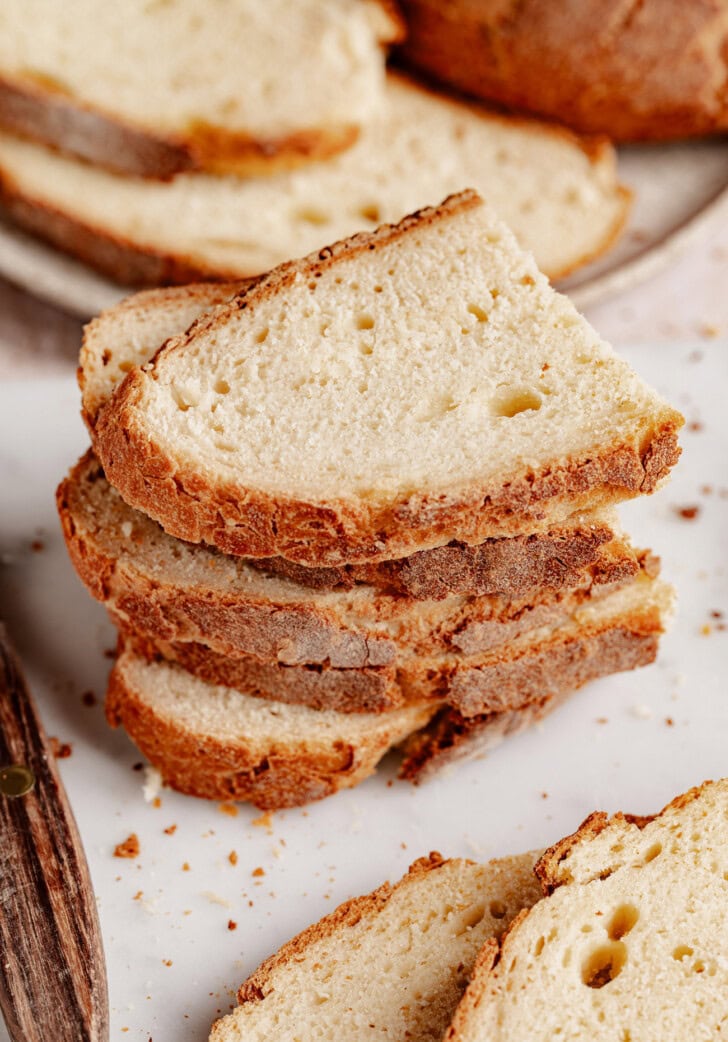
Texture
This bread has a texture similar to classic European style yeast bread loaves. It is crusty on the outside and soft and chewy on the inside.
Expert Tips
- A Dutch oven is ideal for baking this bread because it creates a warm, steamy environment that helps the bread expand and develop its crusty exterior. If you don’t have a Dutch oven you can still make this bread but you need to create a similar closed environment for the bread. I do share in the recipe notes how to bake it without a Dutch oven.
- You can also bake as individual bread rolls which does not require a Dutch oven.

More Bread Recipes
3 Ingredient Cottage Cheese Bread
Ingredients
- 3/4 cup (176g) low fat cottage cheese, see note
- 10 fl oz (296ml) unflavored sparkling or seltzer water, see note before starting
- 4 cups (540g) self-rising flour, see note before starting
Instructions
- Add the cottage cheese to a small blender. Blend on high until completely smooth. Scrape down the sides as needed to help the blender blend.
- Transfer the blended cottage cheese to a large mixing bowl. Stir in the sparkling water until fully combined.
- Add the flour and mix well with a spatula until a shaggy dough forms. If the dough isn’t coming together, add a splash or two of water until it’s easily combined.
- Tightly cover the bowl with plastic wrap. Alternatively, you can also transfer the dough to a proofing container with a lid. Let the dough rest and proof for 6-12 hours in the fridge. The dough will not expand that much when it rests, but you should see that the dough has more air pockets and is wetter.
- About 30 minutes before baking, preheat your oven to 450°F (232°C). Place a large Dutch oven (4.3 quarts or bigger) with its lid on in the lower half of your oven (I recommend adjusting your oven rack to the second lowest spot in your oven and placing your Dutch oven there) while it preheats. This is important. The Dutch oven needs to preheat before adding the bread.
- After the dough has rested, wet your hands with some water. Grab one side of the dough, stretch it upward, and then fold it over the center of the dough. Repeat this process from all eight sides of the dough.
- Lightly flour a work surface with self-rising flour. Carefully turn the dough out onto the floured surface, seam side down. Use a bench scraper or lightly floured hands to rotate and drag the dough towards yourself on the floured surface, until you form a round ball.
- Place the shaped dough, seam side down, onto a piece of parchment paper.
- Remove the preheated Dutch oven from the oven. Remove the lid and carefully transfer the parchment paper with the dough into the hot Dutch oven.
- Put the lid back on and place it back into the oven to bake covered for 45 minutes.
- After 45 minutes, reduce oven to 425°F (218°C), remove the lid and continue baking the bread for another 25 to 30 minutes or until the bread is browned on the surface and sounds hollow when tapped on the bottom. Reducing the oven temperature and baking the bread in the lower half of the oven should help the bread from turning too dark on the surface.
- Let bread cool fully before cutting and serving. Store uneaten bread in an airtight container in the fridge or freezer.
Notes
- Seltzer/sparkling water note: Use a sparkling or seltzer water where the carbonation has been added to it. Don't use a natural sparkling water because some natural ones don't have enough carbonation. The bread relies partially on the carbonation to rise so you want a very bubbly sparkling water. I used La Croix.*
- Cottage cheese note: Make sure to use lowfat cottage cheese and not full fat cottage cheese which will weigh down the dough. Also try to use a cottage cheese with around 13 grams of protein per 1/2 cup serving. I used 1% Amazon Grocery cottage cheese.*
- Self-rising flour amount. There are 2 main kinds of self-rising flour sold in the US. One that is a lower protein (2 grams per 1/4 cup (30g)) flour and one that has a regular amount of protein (3 grams per 1/4 cup (30 g)). The amount of protein affects how much liquid is absorbed. For this recipe, you want a flour with a regular amount of protein. I used Gold Medal*. Please use a self-rising flour with 3 grams of protein per 1/4 cup (30 g). Or make your own self-rising flour with the recipe below.
- *These product links are affiliate links. This means I earn a commission from qualifying purchases.
- Homemade self-rising flour: Combine 4 cups of all purpose flour, 2 tbsp baking powder and 1 tsp salt. Whisk to evenly combine. Make sure your all purpose flour has a regular amount of protein (3 grams per 1/4 cup). Most brands in the US contain this amount but there are some brands with higher protein (4 grams per 1/4 cup) such as King Arthur Flour and Bob's Red Mill. You do not want a high protein flour for this bread. It will be dense and dry.
- Reducing the oven temperature for the last part of baking and baking the bread in the lower half of your oven will help prevent the bread from getting too dark on the surface.
- No Dutch Oven method: A Dutch oven is ideal for baking this bread because it creates a warm, steamy environment that helps the bread expand and develop its crusty exterior. If you don't have a Dutch oven you can still make this bread but you need to create a similar closed environment for the bread. You will need a very large pot/bowl/baking pan that is oven safe at 450F and can fit and cover the bread, with at least 2 extra inches of room on the side and above to allow the bread to expand. When your bread dough is ready, it should be placed on parchment paper lined baking sheet and then covered with your large pot/bowl/baking pan during the first part of baking. The cover is removed for the last part of baking (just like the lid is removed off the Dutch oven).
- You can cut long thin slices of bread (around 16-18). You can also cut the long slices in half again for sandwiches.
Thank you.
You’re welcome! We hope you enjoy this recipe!
Well, I was very skeptical after 50 years of baking, BUT, this turned out great! Thank you!
I’m so glad it turned out well for you!
Success! (Finished bread looks like the pic on the recipe!) Now waiting for it to cool bcuz you said to, but it smells great & I wanna eat some now!!!
We’re so glad you had success with this recipe!
Under seeving size it just says slice… what constitutes a slice? How mmay grams is one slice?
We got 16 slices from this bread. This information is found in the servings section of the recipe card, right underneath the recipe title
Can you use GF flour for the 3 Ingredient Cottage Cheese bread?
Sorry, we haven’t tested this recipe with a gluten free flour!
Love this recipe!
Thank you! We’re so glad you love it!
Can you substitute almond flour and follow your guidelines for making it self rising?
We haven’t tested this recipe with almond flour and using it as a self-rising flour so we’re not sure if the results would be the same!
Would love to make this bread but use only gluten free flour will this is. Has anyone tried it?
We haven’t tested this recipe with a gluten free flour! Let’s see if others have tried it!
Would a one- time (aluminum) serve the purpose?
We haven’t tested this recipe with an aluminum pan.
Nice and easy
Thank you!
Haven’t baked it yet but looks lovely
Thank you! We hope you enjoy it!
Can I use a crockpot method instead of dutch oven?
We haven’t tested this recipe in a crock pot so we’re not sure if that would work. We do have an alternative method in the notes section to make this recipe if you don’t have a Dutch Oven!
Kindly share NO BAKE recipes
Hello! We do have a ton of no bake recipes you can find here.