

3 Ingredient Pumpkin Bread (No Yeast, Eggs, Dairy, Butter or Oil)
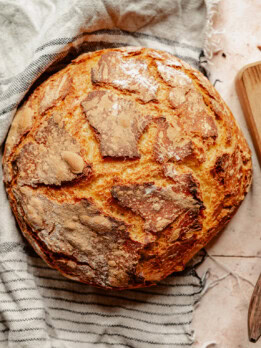
This pumpkin bread is crusty on the outside and soft and chewy on the inside. The bread needs just 3 ingredients and doesn’t contain any yeast, eggs, dairy, butter or oil. The bread has a texture like bread made with yeast but it doesn’t contain any yeast and is easier to make than traditional yeast bread.
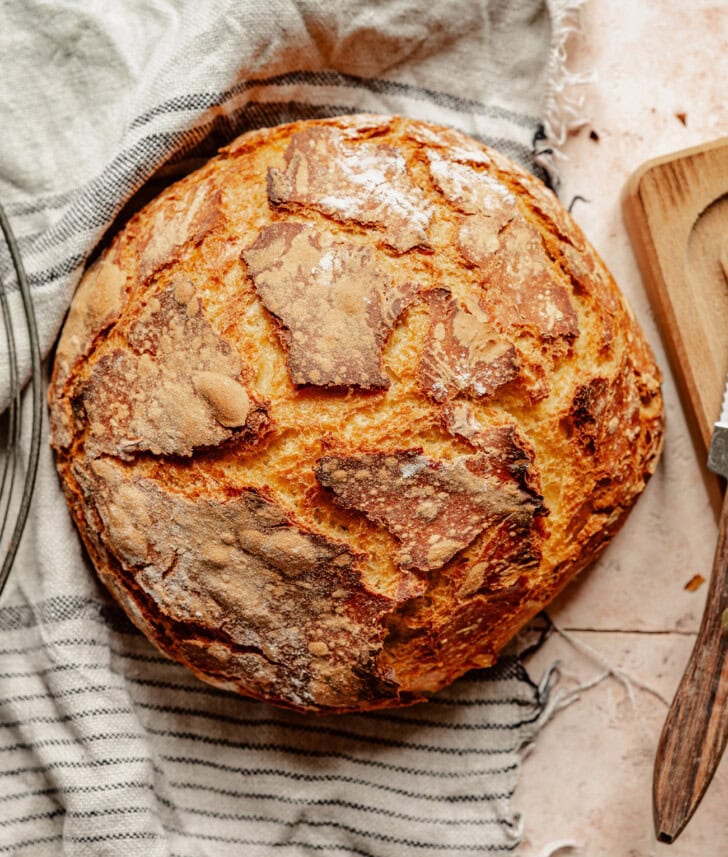
I love making crusty homemade bread this time of year. This bread takes very little effort and is a great recipe for those who don’t like working with yeast but still want to make homemade bread.
Ingredients
- Pumpkin
- Self-rising flour
- Sparkling or seltzer water
Pumpkin: The recipe uses pumpkin puree to give the bread a natural orange color and pumpkin flavor. You can used canned pumpkin puree or homemade pumpkin puree.
Self-rising flour: Self-rising flour is a flour blend that already contains a leavening agent and sodium. Since the bread does not contain yeast, it relies on the leavening agent in the self-rising flour along with the sparkling water to rise and expand.
Sparkling or seltzer water: This recipe works best with a very carbonated water. Natural sparkling water will generally not have enough carbonation. You want one where the carbonation has been added to the water.
How to Make Pumpkin Bread
- The pumpkin and water are first mixed together. The flour is then added in. Mix in the flour until it is fully incorporated and a dough forms.
- You can transfer the dough to a bread proofing container with a lid. You can also keep it in the mixing bowl, but make sure you can tightly cover the mixing bowl. Keep the bread covered for about 4-6 hours.
- About 30 minutes before baking, add your Dutch oven to the oven as it preheats.
- Transfer the dough to a lightly floured surface and form into a taut ball. Place onto a sheet of parchment paper.
- When the oven is ready, carefully transfer the dough with the parchment paper into your Dutch oven.
- Bake for about 40 minutes covered, and then an additional 20-30 minutes uncovered, until the bread is done.
- Allow the bread to cool fully before cutting and serving.
Texture
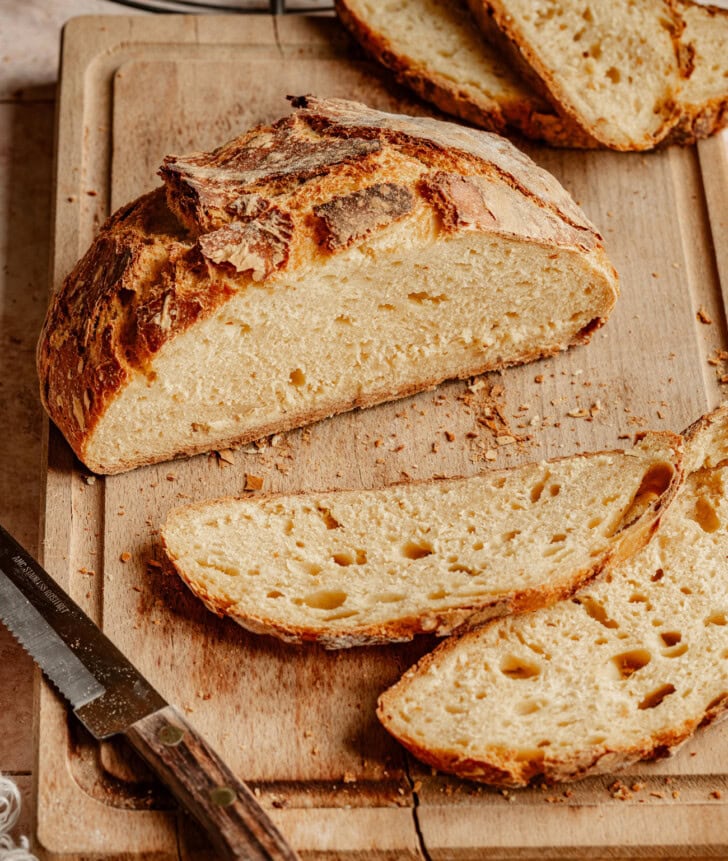
This bread has a texture similar to European-style artisan bread. It is crusty on the outside and soft and chewy on the inside.
Expert Tips
- It is possible to make this bread without a Dutch oven but you would need a very large oven-safe pot or baking dish to cover the bread during baking. This method is explained in further detail in the notes section of the recipe card.
- Avoid adding too much pumpkin puree. This will cause the bread to turn out gummy.
- Make sure your water is very carbonated. If the water is not bubbly enough, the bread will come out dense.
More No Yeast Bread Recipes
3 Ingredient Pumpkin Bread
Ingredients
- 8 fl oz (237ml) unflavored sparkling/seltzer water, see note before starting
- 2/3 cup (151g) pumpkin puree
- 4 cups (540g) self-rising flour, see note before starting
Instructions
- In a large glass mixing bowl, whisk together the sparking water and pumpkin puree until evenly combined. Add the flour and mix well with a spatula until a shaggy dough forms. If the dough isn’t coming together, add a splash or two of sparkling water until it’s easily combined. You do want the dough to be on the drier side, but all the flour should be incorporated. The dough will get wetter as it rests.
- If you have a bread proofing container with a lid, you can transfer the dough into it and tightly cover it. Otherwise, you can keep the dough in the glass mixing bowl but make sure to tightly cover it with a lid, plastic wrap or something similar. Keeping the dough covered tightly will prevent the dough from discoloring and will also help it rise better. Let the dough rest and proof for 4-6 hours.
- About 30 minutes before baking, preheat your oven to 450°F (232°C). Place a large Dutch oven (4.3 quarts or bigger) with its lid on in the oven while it preheats. This is important. The dutch oven needs to preheat before adding the bread. See notes section for how to make this bread without a Dutch oven.
- After the dough has rested, wet your hands with some water. Grab one side of the dough, stretch it upward, and then fold it over the center of the dough. Repeat this process from all eight sides of the dough.
- Lightly flour a work surface with self-rising flour. Carefully turn the dough out onto the floured surface, seam side down. Use a bench scraper or lightly floured hands to rotate and drag the dough towards yourself on the floured surface, until you form a round ball.
- Place the shaped dough, seam side down, onto a piece of parchment paper.
- Remove the Dutch oven from the preheated oven. Remove the lid and carefully transfer the parchment paper with the dough into the hot Dutch oven.
- Put the lid back on and place it back into the oven to bake covered for 40 minutes.
- After 40 minutes, reduce oven temperature to 400°F (204°C). Remove the lid and continue baking the bread for another 20-30 minutes or until the bread is browned on the surface and sounds hollow when tapped on the bottom.
- Let bread cool fully before cutting and serving. Store uneaten bread in an airtight container in the fridge or freezer.
Notes
- Seltzer/sparkling water note: You can use seltzer water or sparkling water. Whichever one you choose, make sure it is one that has carbonation added to it and is very bubbly. The bread relies partially on the carbonation to rise. Don't use a natural sparkling water because some natural ones don't have enough carbonation.
- Self-rising flour amount. There are 2 main kinds of self-rising flour sold in the US. One that is a lower protein (2 grams per 1/4 cup (30g)) flour and one that has a regular amount of protein (3 grams per 1/4 cup (30 g)). Brands like King Arthur Flour and White Lily make the low protein flour. Brands like Gold Medal* and most store/generic brands contain a regular protein amount. The amount of protein affects how much liquid is absorbed. For this recipe, you want a flour with a regular amount of protein. Please use a self-rising flour with 3 grams of protein per 1/4 cup (30 g). Or make your own self-rising flour with the recipe below.
- *This product link is an affiliate link. This means I earn a commission from qualifying purchases.
- Homemade self-rising flour: Combine 4 cups of all purpose flour, 2 tbsp baking powder and 1 tsp salt. Whisk to evenly combine. Make sure your all purpose flour has a regular amount of protein (3 grams per 1/4 cup). Most brands in the US contain this amount but there are some brands with higher protein (4 grams per 1/4 cup) such as King Arthur Flour and Bob's Red Mill. You do not want a high protein flour for this bread. It will be dense and dry.
- Pumpkin puree: You can use homemade or canned pumpkin puree. I used canned.
- No Dutch Oven method: A Dutch oven is ideal for baking this bread because it creates a warm, steamy environment that helps the bread expand and develop its crusty exterior. If you don't have a Dutch oven you can still make this bread but you need to create a similar closed environment for the bread. You will need a very large pot/bowl/baking pan that is oven safe at 450F and can fit and cover the bread, with at least 2 extra inches of room on the side and above to allow the bread to expand. When your bread dough is ready, it should be placed on parchment paper lined baking sheet and then covered with your large pot/bowl/baking pan during the first part of baking. The cover is removed for the last part of baking (just like the lid is removed off the Dutch oven).
Love this recipe! The bread cones out like sourdough with this amazing crust. Thanks so much for sharing this recipe!
Thank you! I’m so glad you like it!
Making it now, hoping for the best. Have a put of soup on to go with the bread. Easy to assemble
Yum! We hope you enjoyed it!
Can I replace the Sparking Water with a 12oz bottle of beer ?
We haven’t tested this recipe with beer instead of sparkling water so we’re not sure if that would work the same!
What happens if you use King Arthur flour? Do you have to use a glass bowl? Do you proof the dough for 4-6 hrs in the frig or on the counter?
If you use King Arthur self-rising flour, your bread dough will be too wet because King Arthur self-rising flour is a low protein flour. If you use King Arthur all purpose flour to make your own self-rising flour blend, your dough will be too dry because King Arthur ap flour is high protein flour. You don’t have to use a glass bowl. We recommend using a bowl or container that is clear so that you can see the progress of the dough.
I haven’t made the bread because I need clarity on the seltzer water.
How do I know how much carbonation there is in a bottle or can?
I need a brand recommendation.
We use La Croix sparkling and Polar seltzer.
I let this thing rise for 6 hours and it doesn’t look any bigger than when I made it… I guess my sparkling water wasn’t bubbly enough.. that’s the only thing I can think of.. it’s in the oven now so I guess it could rise in the oven but I’m not that hopeful ?
It should rise more while baking. We use La Croix sparkling and Polar seltzer. Hopefully it turned out well.
Can gluten free flour be used?
We haven’t tested this recipe with a gluten free flour so we aren’t sure!
Is it possible to use gluten free flour in this recipe?
We haven’t tested this recipe with a gluten free flour so we aren’t sure!
Jennifer, Excellent recipe! Came out Perfect ! Thank you for the percise directions as all of your recipes have. I know I can count on what to expect with your recipes each time! I wish you would write a book!
I also made the pumpkin oatmeal bars as I had enough pumpkin to do and they are perfect too! DELISH!
Best wishes,
Donna
Thank you Donna! We’re so glad you loved this recipe!
Any way to use almond flour along with yeast? I need to cut the carbs.
We haven’t tested this recipe with that substitution so we’re not sure if the results would be the same!
Have you ever added any piece to your bread like pumpkin pie spice? My family and I love pumpkin everything but we also love the spices. I am wondering if adding them would make a difference since your recipe sounds very sensitive.
We haven’t tried adding spices but it should work. Let us know if you give it a try!
I’m on a low sodium diet. Where does all the sodium come from? 566 mg per slice is astronomical.
The sodium comes from the self-rising flour. You can make your own self-rising flour blend and reduce the amount of salt added.
These King Arthur statements are contradicting but it isn’t the “regular protein” amt that you.mention, so I guess it doesn’t matter. I’ll stick with the 3gm/¼ up. Recipe sounds amazing!!
Brands like King Arthur Flour and White Lily make the low protein flour. There are 2 main kinds of self-rising flour sold in the US. One that is a lower protein (2 grams per 1/4 cupMost brands in the US contain this amount but there are some brands with higher protein (4 grams per 1/4 cup) such as King Arthur Flour and Bob’s Red Mill. You do not want a high protein flour for this bread. It will be dense and dry.
The statements actually aren’t contradicting. The first statement on King Arthur discusses their self-rising flour, which is a low protein self-rising flour, unlike most self-rising flour which contains a regular amount of protein. The second statement is discussing different brands of all purpose flour and is stating that King Arthur makes a high protein all purpose flour that has higher protein than regular all purpose flour.
Thank you for your nutritious and healthier bread versions!
You’re welcome! We’re glad you enjoyed this recipe!
Do you think the 3 ingredient pumpkin bread work with gluten free flour?
We haven’t tested this recipe with a gluten free flour so we aren’t sure!