

3 Ingredient Pumpkin Rolls (No Yeast, Eggs, or Dairy)
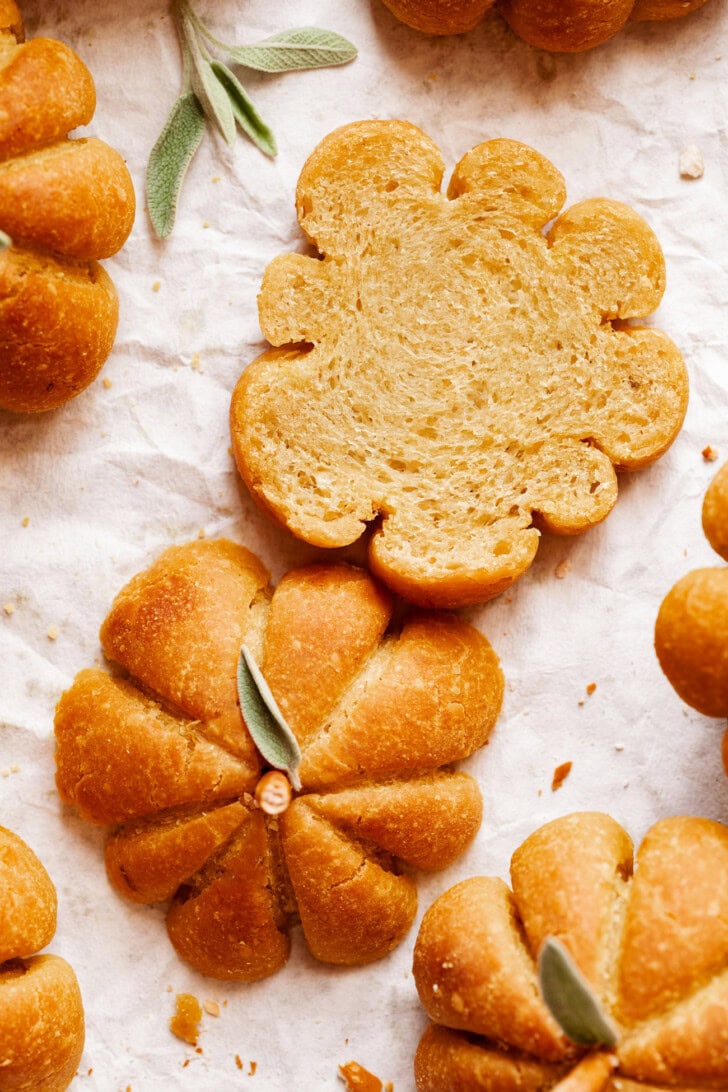
These pumpkin bread rolls are soft and fluffy. They only need 3 ingredients and don’t require any yeast, eggs or dairy. You also don’t have to knead the dough. The bread rolls taste like bread made with yeast even though they don’t contain any yeast.
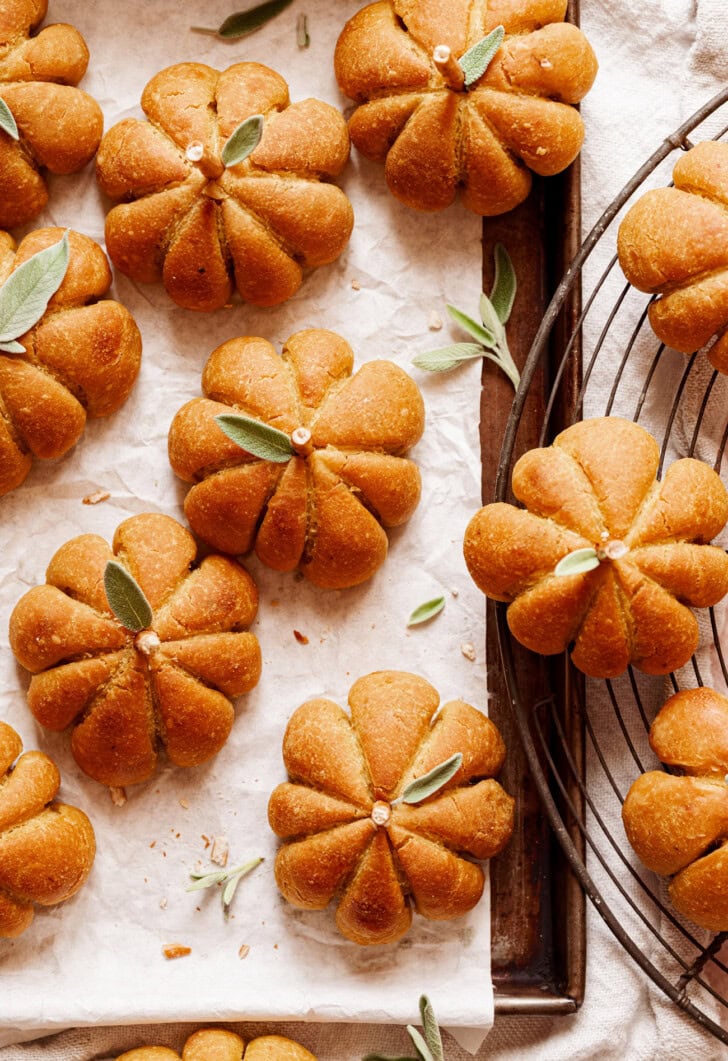
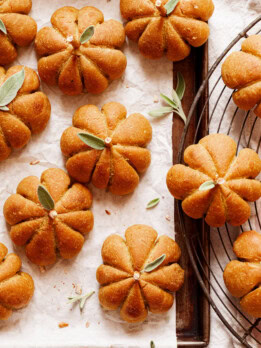
These pumpkin rolls are a nice festive side dish. You can make them like regular bread rolls or take the extra step of making them pumpkin shaped.
Ingredients
- Pumpkin
- Sparkling water
- Self-rising flour
Optional finish: The bread rolls will turn out a light orange without the optional finish. If you want a more saturated color, I recommend brushing the bread rolls with turmeric butter (tumeric powder mixed with melted butter). You can also use a dairy free butter substitute.
Pumpkin: This recipe uses pumpkin puree to give the bread its pumpkin flavor. You can use homemade pumpkin puree or canned pumpkin puree.
Sparkling water: You can use sparkling or seltzer water. Whichever one you choose, make sure the water is very carbonated. Avoid using natural sparkling waters because they often don’t contain as much carbonation.
Self-rising flour: Self-rising flour is a flour blend that already includes a leavening agent and salt. Since the bread is made without yeast, it uses self-rising flour to help it rise. You can also make a homemade self-rising flour blend if you don’t have self-rising flour on hand.
How to Make Pumpkin Bread Rolls
- The pumpkin and sparkling water are mixed together. The flour is then added in until a dough forms.
- Tightly cover the bread and let it rest for a few hours.
- Preheat your oven and add a cast iron skillet to the bottom section of your oven. Divide the dough it into 12 equal pieces. Shape each piece into a ball.
- Place the rolls onto your prepared baking sheet. If desired, brush the balls with optional turmeric butter. Add hot water to the cast iron skillet in your oven to create steam and then place the rolls into the oven to bake until golden and done.
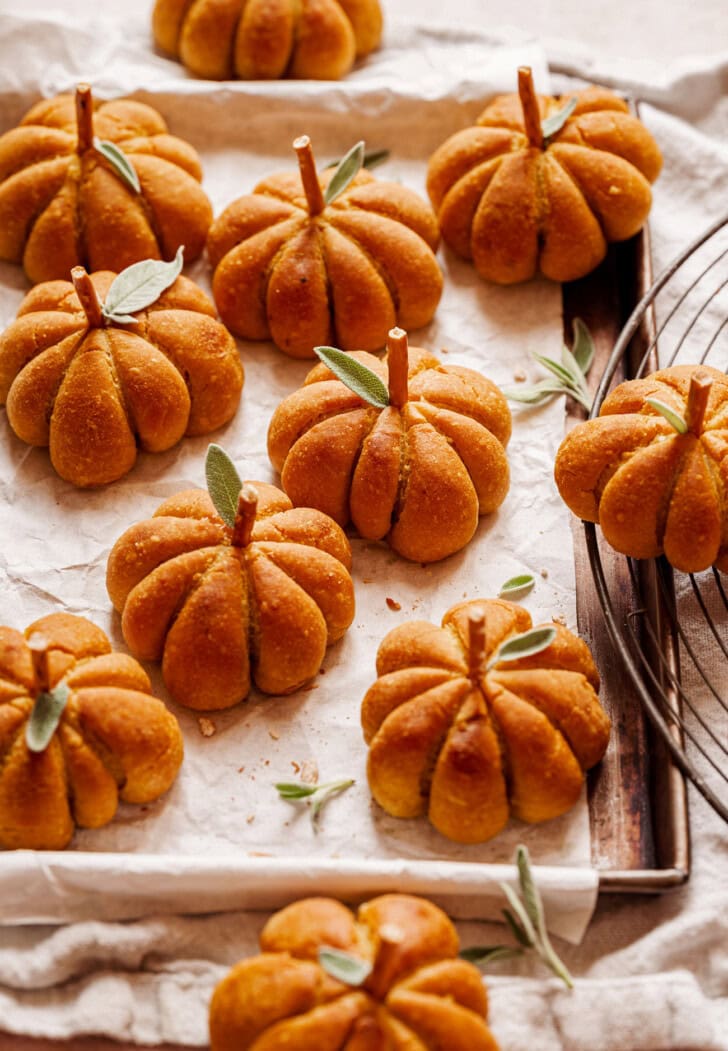
How to Make Them Pumpkin-Shaped
- Instead of shaping the rolls into regular round balls, you can take the extra step of making them pumpkin-shaped.
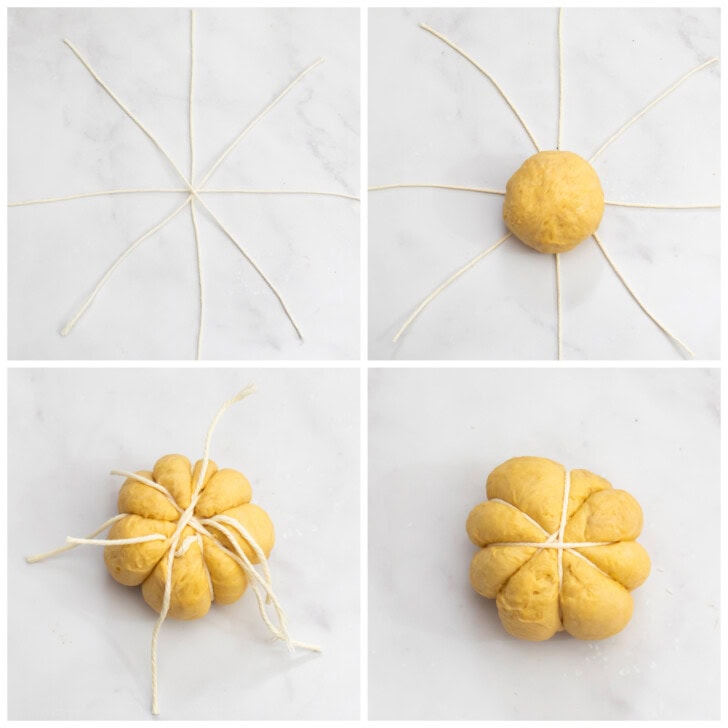
- For each roll, you will need four 10-inch long strands of kitchen twine.
- Lightly oil the twine so it won’t stick to the dough.
- Arrange the four pieces of twine into a plus sign with diagonals pattern. Place one dough ball, taut side down, directly on top of the center where the twine meets.
- Bring the ends of one piece of twine up and over the dough ball and tie them loosely on top. Repeat with the opposite piece so the dough is divided into quarters. Continue with the remaining two pieces of twine, crossing diagonally, until the ball is sectioned into eight even wedges, creating pumpkin-like ridges.
- The twine should be tied loosely so that there is room for the bread to expand a little. Trim off the excess ends of the twin. Flip the ball over so the ends of the twine are tucked into the bottom of the bread and place the bread onto your prepared baking sheet.

- If desired, when the bread rolls are done baking, you can add pretzel sticks to make stems and garnish with sage leaves for decoration.
Expert Tips
- The easiest way to make these breads is to skip the pumpkin shaping, but the pumpkin shaped version is great for serving during the holidays or for an event.
- The bread rolls will still turn out well without the turmeric butter but the turmeric does help the rolls have more color.
- The cast iron skillet with water helps create a steamy environment for the bread, which helps them rise better.
More Bread Recipes
- 2 Ingredient Shortcut Sourdough Bread Rolls
- 2 Ingredient Cottage Cheese Rolls
- 4 Ingredient Pumpkin Dinner Rolls
3 Ingredient Pumpkin Rolls
Ingredients
- 8 fl oz (237ml) unflavored sparkling/seltzer water, see note before starting
- 2/3 cup (151g) pumpkin puree
- 4 cups (540g) self-rising flour, see note before starting
Instructions
- In a large glass mixing bowl, whisk together the sparkling water and pumpkin puree until evenly combined. Add the flour and mix well with a spatula until a shaggy dough forms. If the dough isn’t coming together, add a splash or two of sparkling water until it’s easily combined.
- Tightly cover the bowl with plastic wrap or a lid and let rest at room temperature for 3-5 hours. The dough will not rise as much as a traditional yeast dough. Your dough is ready when it has risen a little, is wetter than before and if you look at the bottom of the glass bowl there should be large bubbles in the dough.
- About 30 minutes before baking, preheat your oven to 400°F (205°C). Add a large cast iron skillet to the bottom rack of the oven while it preheats. Bring a tea kettle or pot of water to a boil.
- After the dough has rested, wet your hands with some water. Grab one side of the dough, stretch it upward, and then fold it over the center of the dough. Repeat this process from all eight sides of the dough.
- Lightly flour a work surface with self-rising flour. Carefully turn the dough out onto the floured surface, seam side down. Use a bench scraper or sharp knife to divide the dough into 12 equal portions (use scale if possible).
- Shape each piece into a ball by pulling the edges to the center and pinching to seal. Place seam side down on your work surface and roll under your hand to create tension and form a round, taut ball. If you want to shape your bread to be pumpkin shaped, continue to the next step. If you are going to keep the bread as regular rolls, skip to step 10 .
- Optional pumpkin shaping: Cut four 10-inch pieces of kitchen twine for each roll. Lightly oil the twine so it won’t stick to the dough. On your work surface, arrange the four pieces of twine in a star or “plus sign with diagonals” pattern — like spokes of a wheel — so they intersect in the center. See photo in post for reference. Place one dough ball, taut side down, directly on top of the center where the twine meets.
- Bring the ends of one piece of twine up and over the dough ball and tie them loosely on top. Repeat with the opposite piece so the dough is divided into quarters. Continue with the remaining two pieces of twine, crossing diagonally, until the ball is sectioned into eight even wedges, creating pumpkin-like ridges. Be careful not to tie too tightly; the dough needs room to expand as it rises. Trim any excess twine. Flip the roll over so the taut, rounded side is facing up and the knots are underneath.
- Transfer to a parchment-lined baking sheet, spacing 1½ to 2 inches apart. Repeat with remaining dough balls. Set aside.
- For a more golden-orange finish, stir together 4 tablespoons melted butter with ½ teaspoon turmeric. Brush the rolls lightly with mixture. The rolls will still turn out a light orange without the turmeric finish but the turmeric will give the rolls a more saturated color.
- When oven is ready, carefully pour hot/boiling water into the cast iron skillet in the preheated oven, creating steam.
- Then quickly add the tray of rolls to the oven rack above the water and bake for 20 to 25 minutes until golden brown and crusty on the outside. Remove the rolls from the oven and immediately brush with another layer of turmeric butter while they’re still hot for a deeper color and glossy finish. If making pumpkin shaped rolls, cut and remove the twine after the rolls are out of the oven and before the final brushing of tumeric butter.
- Transfer to a wire rack and let cool for at least 30 minutes before serving.
- If making pumpkin shaped rolls, you can also insert a pretzel or cinnamon stick into the rolls to make stems and garnish with small sage leaves. Breads are best enjoyed soon after they are done baking. Uneaten leftover bread should be stored in an airtight container in the fridge or freezer.
Notes
- Seltzer/sparkling water note: You can use seltzer water or sparkling water. Whichever one you choose, make sure it is one that has carbonation added to it and is very bubbly. The bread relies partially on the carbonation to rise. Don't use a natural sparkling water because some natural ones don't have enough carbonation. I used La Croix sparkling water* for these bread rolls.
- Self-rising flour amount. There are 2 main kinds of self-rising flour sold in the US. One that is a lower protein (2 grams per 1/4 cup (30g)) flour and one that has a regular amount of protein (3 grams per 1/4 cup (30 g)). Brands like King Arthur Flour and White Lily make the low protein flour. Brands like Gold Medal* and most store/generic brands contain a regular protein amount. The amount of protein affects how much liquid is absorbed. For this recipe, you want a flour with a regular amount of protein. Please use a self-rising flour with 3 grams of protein per 1/4 cup (30 g). Or make your own self-rising flour with the recipe below.
- *These product links are affiliate links. This means I earn a commission from qualifying purchases.
- Homemade self-rising flour: Combine 4 cups of all purpose flour, 2 tbsp baking powder and 1 tsp salt. Whisk to evenly combine. Make sure your all purpose flour has a regular amount of protein (3 grams per 1/4 cup). Most brands in the US contain this amount but there are some brands with higher protein (4 grams per 1/4 cup) such as King Arthur Flour and Bob's Red Mill. You do not want a high protein flour for this bread. It will be dense and dry.
- Estimated nutrition does not include optional turmeric butter finish.
I honestly think I’ve only ever written two recipe reviews now, and they’re both for Kirbie’s.
I found this recipe the day before American Thanksgiving and made a batch of buns that night as well as the day of Thanksgiving.
I made the two batches in essentially the same manner, but having used two different measuring vessels (since the dishwasher is a revolving door around the holidays) for each, I think the first batch wound up with slightly more flour than the second. This resulted in a dough that was ultimately easier to work with than the second batch, which had a stickier dough. I let them both rise for about three hours and they both turned out quite good, though.
Towards the end of the dough rising and while the oven was preheating, I sprayed down the hanks of kitchen twine with avocado oil from a sprayer, not an aluminum can of cooking spray, and let them soak.
Aside from perhaps extra flour in the first batch, I also dumped the flour in all at once and just sorta powered through mixing it. The buns were very satisfying to touch, quite heavy and had a silky mochi feeling. I was torn by concurrent urges to take a huge bite out of the raw dough as well as wanting to throw one against the wall just to hear what it’d sound like. I was fortunately successful in quelling these desires.
Also, due to a combination of me having made the first batch late at night, being bad at math, and having been distracted by my traditional Thanksgiving horror movies (IT Chapter 1 in this case), I wound up with only eight large shibari buns. Since they were already trussed up by the time I’d noticed, I basted them in turmeric butter and popped em in the oven.
I definitely tied the first batch too tight, and this resulted in what appeared to be split garlic cloves rather than pumpkins. However, I leaned into this and added some Kinder’s garlic seasoning to the remaining turmeric butter and doused the buns. After letting them cool I freed them from their bindings, but the buns were left with, how to put this delicately…fuzzy bortholes.
I would NOT recommend skipping the twine, though, fuzzy bortholes be damned! Even on the buns that didn’t wind up resembling garlic cloves, you could essentially peel the sections off like an orange and those pieces were wonderfully reminiscent of garlic knots. After peeling off all the “cloves,” you’re left with a delightfully soft bread center.
Learning from the first batch, I made a couple changes when making the second batch. Unintentionally, I think I used less flour. Very intentionally though, I poured the flour into the wet ingredients just a portion at a time to make it easier to incorporate, rather than just dumping it all in. I also soaked the twine longer and in more oil.
The other thing I did was remember to COUNT the buns before tying them up into pumpkins. However, distracted by IT Chapter 2, I still wound up with exactly eight buns. So, I just reportioned the dough to make up the missing numbers. I also tied the twine looser. Despite oiling the twine extra and tying it loosely…the bortholes. They were still fuzzy. So maybe I just need better kitchen twine.
It was very comforting to me that I could have two comparatively different doughs that wound up still creating the same buns, which makes the recipe seem very forgiving.
I thought these buns were great! I brought some buns from both batches to my family’s Thanksgiving dinner, but they were less of a hit there. There was one kid that was absolutely jazzed about them and the only thing he ate was the buns and like three bites of turkey, but the adults did not share this enthusiasm. One common comment was, “while they were good, they were a bit too heavy on top of a Thanksgiving dinner.” Which sounds like a skill issue on their part, honestly. But that just meant more for me and that kid c:
I had quite a few leftover buns, and got creative with how to use them up over the next several days, including:
-Briefly microwaving them to warm the center and then crisping them up in the air fryer
-Using them for various sandwiches, including meat and cheese as well as pulled barbecue chicken
-Making a standard eggs and sausage breakfast in the pan, then slicing the buns and heating them in the nice leftover butter/oil (bonus points, putting a runny egg on top or using the bun to mop up yolk)
With this recipe, La Croix has earned my grudging respect. However, I’m fascinated by the idea of creating a dessert version of this recipe, perhaps involving a can of root beer and a cinnamon icing glaze.
Anyways, that’s enough rambling now, but I’ve been meaning to write this review since November 27th.
Thank you so much for sharing your experience with this recipe! We’re so glad that you enjoyed them and love the way you used them for leftovers!
Hi,
Recipe doesn’t mention at which point does the tied twine come off the rolls – before or after they’re baked, and how is this done.
Thanks
Cut and remove the twine after the rolls are out of the oven and before the final brushing of turmeric butter. There are instructions and pictured throughout the post and in the recipe card on how to use the twine to make the pumpkin shape!
That is fantastic.Love more recipes like this one pumpkin
We’re so glad you loved this recipe!
Could you make these with a gluten free self rising flour?
Sorry, we haven’t tested these with a gluten free self rising flour!
This a great and easy yet delicious recipe!
We’re so glad you enjoyed this recipe!