

4 Ingredient Donut Focaccia (No Yeast or Eggs)
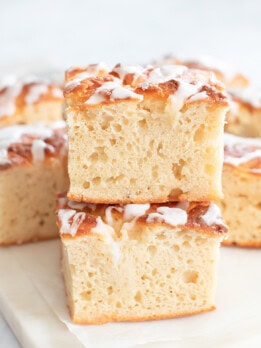
This donut focaccia is crispy around the edges and soft and fluffy in the center. It only needs 4 ingredients and doesn’t require any yeast or eggs. There is no kneading or frying required. This dessert can be customized and is great for brunch or other events.
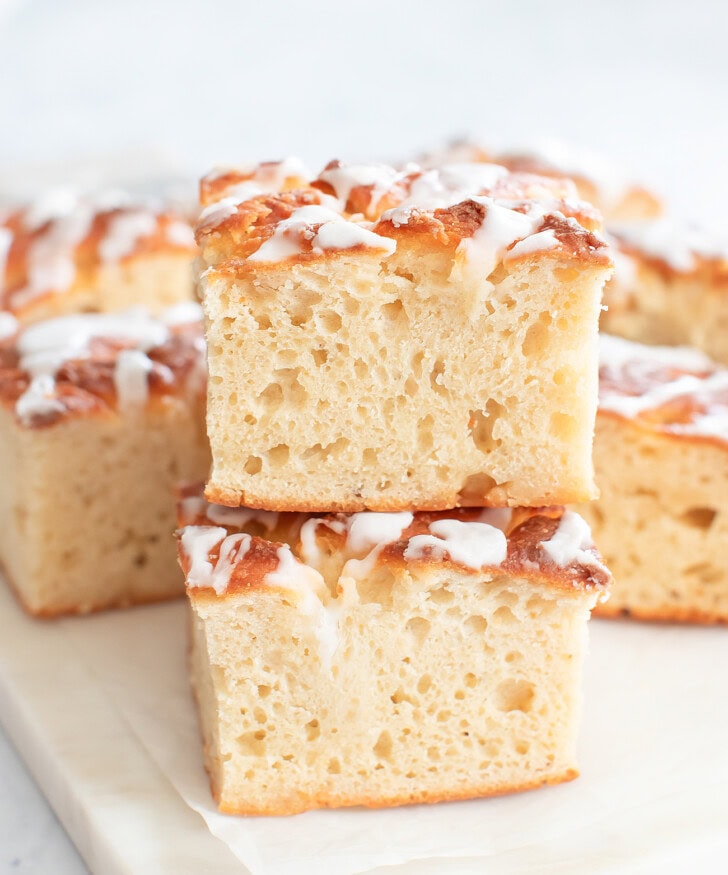
This donut focaccia is so easy to make and tasty. I’ve already made it for my family for weekend brunch several times. I love how crispy the edges are and the center is soft, airy and chewy like traditional focaccia. The dough is lightly sweetened and topped with powdered sugar or glaze so that it tastes like donuts.
Ingredients
- Self-rising flour
- Vanilla yogurt
- Canola oil
- Powdered sugar
Self-rising flour: Self-rising flour is a flour blend that already includes a leavening agent. Since this recipe is made without yeast, it relies on the leavening agent in the self-rising flour to rise. If you don’t have self-rising flour on hand, you can make a homemade version with all purpose flour, baking powder and salt.
Vanilla yogurt: The dough is made with sweetened vanilla whole milk yogurt. It’s important that you use regular yogurt and not Greek yogurt. Greek yogurt contains too much protein and will make the dough too dense. Whole milk yogurt keeps the bread very soft and light. The sugar in the vanilla yogurt also lightly sweetens the dough, making it taste more like a donut.
Canola oil: You want to use canola oil or another neutral flavored oil. While focaccia usually uses olive oil, you don’t want to use olive oil in this version because the olive oil flavor is very strong and doesn’t go well with the sweet donut flavor.
Powdered sugar: You can finish the donut focaccia with a dusting of powdered sugar, or you can mix the powdered sugar with a little bit of water to create an easy glaze that can be drizzled over the bread.
How to Make Donut Focaccia
- The flour and yogurt are mixed together until a dough forms. Add 1 tbsp of oil to your proofing container or a large glass mixing bowl. Add the dough and coat it in the oil. Cover your container and let the dough rest about 4 hours or until it has doubled in size.
- Once the dough is ready, coat the interior of your baking pan with oil, making sure the bottom and sides are completely coated. Place the dough into the baking pan and stretch to spread it out evenly across. Lightly cover and let it rest for for about 20-25 minutes.
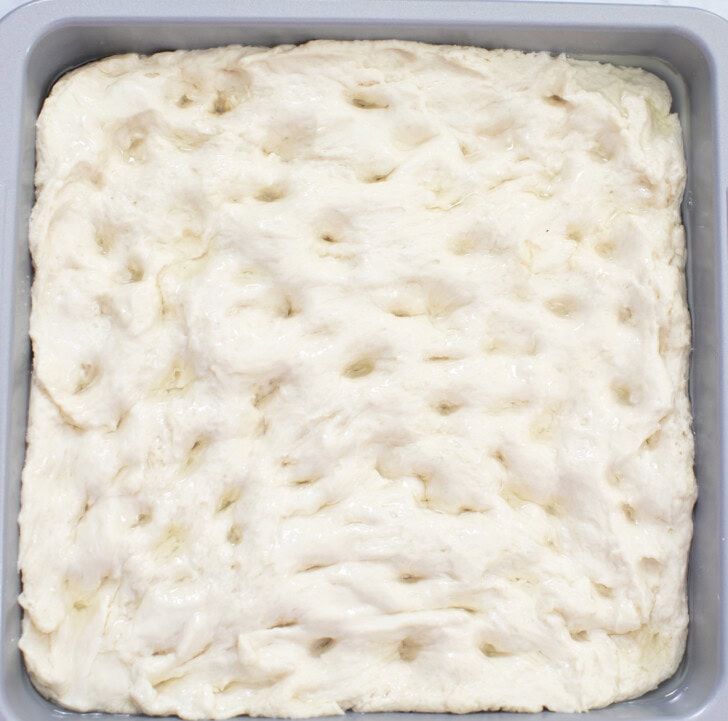
- Preheat your oven. When your dough is ready and oven is ready, drizzle the remaining oil over the surface of the dough. Then use your fingers to create deep dimples across the surface of the dough.

- Bake the bread for about 30 minutes or until done. The surface should be a deep golden brown.
- Allow the bread to cool before adding powdered sugar or glaze. Bread is best served a little warm, while the edges and bottom are crispy.
Expert Tips
- You want to be careful to not mix the oil into the dough. Doing so will cause the dough to be dense and gummy. The dough is coated in oil so that it develops a crispy exterior.
- You can also bake this in a cast iron skillet. The edges get even crispier with a cast iron skillet.
- If you are using a baking pan, I recommend a metal nonstick baking pan and not a glass baking pan because a metal pan will allow the edges to crisp up better.
- For a thicker focaccia, use an 8 inch pan. For a thinner focaccia, use a 9 inch pan.
More No Yeast Bread Recipes
4 Ingredient Donut Focaccia
Ingredients
- 4 cups (552g) self-rising flour, see note before starting
- 2 1/3 cups (598g) vanilla whole milk yogurt
- 3 tbsp (44ml) canola oil, divided
- 1 cup (125g) powdered sugar
Instructions
- In a large glass mixing bowl, combine the flour and yogurt. Mix well with a spatula until a shaggy dough forms. The dough will be sticky and wet.
- Pour 1 tablespoon of oil in a clean large glass mixing bowl or a proofing container. Add the dough and toss to evenly coat all around the dough. Tightly cover with plastic wrap or cover with lid and let rest until doubled in size and bubbly, about 4 hours. Your dough is ready when it has risen (about double in size), is wetter than before and if you look at the bottom of the glass bowl, there should be large bubbles in the dough. I found that the bread proofs better and faster in a proofing container with a lid (I used a 3 quart container). If you are leaving the bread to rise for more than few hours, you will need to put it in the fridge. The dough takes much longer to rise in the fridge but it will rise.
- Grease an 8-inch nonstick metal pan with 1 heaping tablespoon of oil, ensuring the bottom and sides are well coated. You can also use a 9-inch square pan but your focaccia will be thinner. You can also use an 8 or 9 inch cast iron skillet for an even crispier bottom.
- Transfer the rested dough to the prepared pan. Gently stretch the dough to fit the pan. Gently cover and let it rest for 20-25 minutes while the oven heats up.
- Preheat your oven to 400°F (200°C).
- When your oven and dough are ready, drizzle the remaining 1 tablespoon of oil over the dough. Use your fingertips to press dimples into the dough’s surface. Make sure to press all the way down until you touch the bottom of the pan.
- Bake in the preheated oven for 30 to 35 minutes, until deep golden brown on the surface and cooked through. Let the focaccia cool in the pan before removing it.
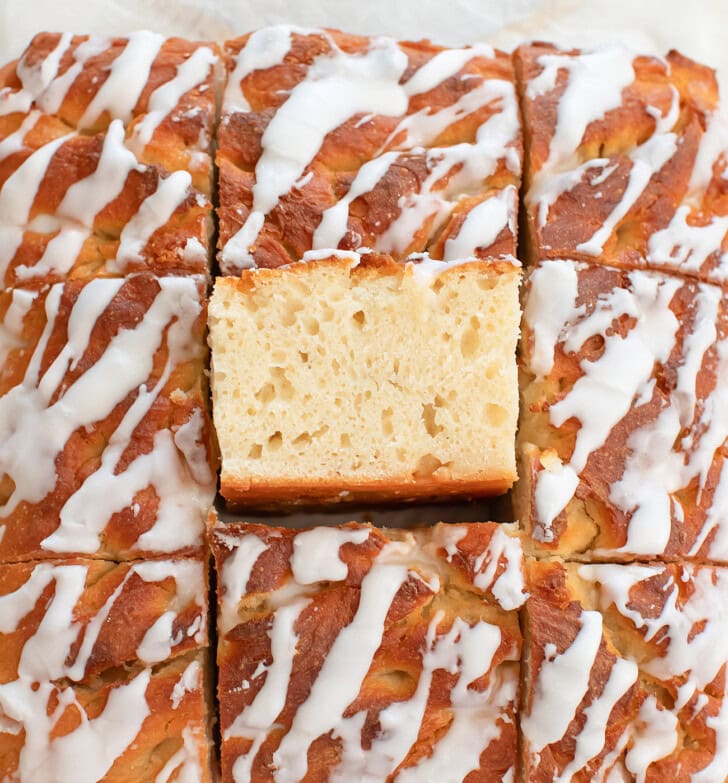
- The focaccia is best enjoyed slightly warm or soon after it is baked, while the bottom and edges are crispy. Right before serving, you can dust the focaccia with powdered sugar. If you prefer a glaze, whisk the powdered sugar and 1-2 tablespoons of water until smooth and pourable. Drizzle onto the surface. Slice the focaccia with a sharp knife. Store any uneaten focaccia in an airtight container in the fridge.
Notes
- Self-rising flour note: There are 2 main kinds of self-rising flour sold in the US. One that is a lower protein (2 grams per 1/4 cup (30g)) flour and one that has a regular amount of protein (3 grams per 1/4 cup (30 g)). The amount of protein affects how much liquid is absorbed. For this recipe, you want a flour with a regular amount of protein. I used Gold Medal*. Please use a self-rising flour with 3 grams of protein per 1/4 cup (30 g). Or make your own self-rising flour with the recipe below.
- Homemade self-rising flour: Combine 4 cups of all purpose flour, 2 tbsp baking powder and 1 tsp salt. Whisk to evenly combine. Make sure your all purpose flour has a regular amount of protein (3 grams per 1/4 cup). Most brands in the US contain this amount but there are some brands with higher protein (4 grams per 1/4 cup) such as King Arthur Flour and Bob's Red Mill. You do not want a high protein flour for this bread. It will be dense and dry.
- Yogurt note: I used Stonyfield vanilla yogurt.* Make sure you use regular yogurt and not Greek yogurt.
- *These product links are affiliate links. This means I earn a commission from qualifying purchases.
- Estimated nutrition does not include the glaze because how much glaze used or how much powdered sugar you are using for dusting is going to vary. You can also eat this without any glaze because it is lightly sweet on its own.
Could you use different flavors of yogurt.
We haven’t tested that with this recipe! As long as it’s a whole milk yogurt we think it should work.
I made it
We’re glad you enjoyed it!
Can I make this recipe gluten free I have some friends I would love to serve this to
Sorry, we haven’t tested this recipe with a gluten free flour so we’re not sure what the best substitute would be!
I’d like to make this but I have a few questions. Can you use avocado oil instead of canola oil? Can you use an 8 inch glass dish? What is the purpose of the last tablespoon of oil and poking the dough through to the bottom of the pan? It sounds delicious and I hope to make it soon.
You could try using avocado oil or another neutral flavored oil we don’t recommend using olive oil. We don’t recommend a glass baking dish because it takes longer for the bread to bake and it won’t develop a crispy exterior. You drizzle the remaining 1 tablespoon of oil over the dough when the oven and dough are ready. The step with making dimples creates the classic focaccia texture and helps it bake properly.