
Baking 101: Liquid vs Dry Measuring Cups
Let’s talk measuring cups. When you shop for measuring cups, there are ones meant for wet ingredients and ones meant for dry ingredients. You’ve probably heard the expression: Baking is a Science.
Many baking recipes require very precise measurements to achieve the chemical reactions needed to produce the correct results. Leave out certain ingredients, add the wrong amounts and your recipe will very likely fail or not turn out properly. This is why it’s important that you own both sets of measuring cups if you plan on baking. Otherwise, your ingredient measurements will likely be off.
Liquid vs. Dry
So why are different sets of measuring cups used?
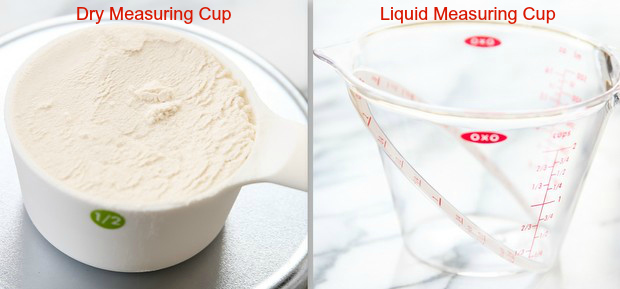
Measuring dry ingredients
Let’s say your recipe calls for 1/2 cup of all purpose flour. To measure out 1/2 cup of flour, you choose your 1/2 dry measuring cup, fill it to the top with flour, and then level off the top, giving you exactly 1/2 cup.
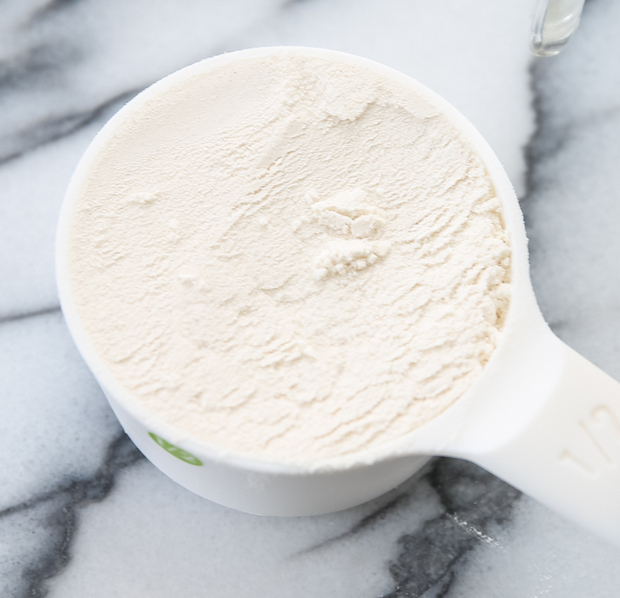
Now, let’s say you only have a wet measuring cup. You can scoop your flour into your liquid measuring cup until it reaches the 1/2 cup mark. But you can’t level it off. The surface of the flour is uneven, with some parts higher than others. So you don’t really have 1/2 cup. Instead, you have around 1/2 cup.
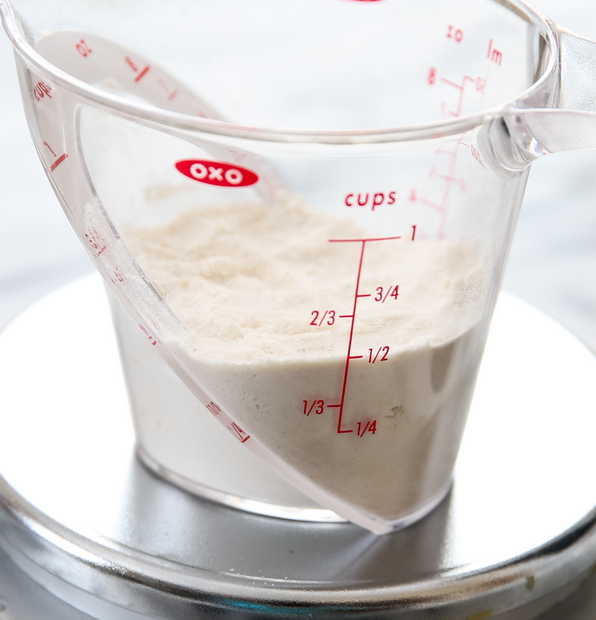
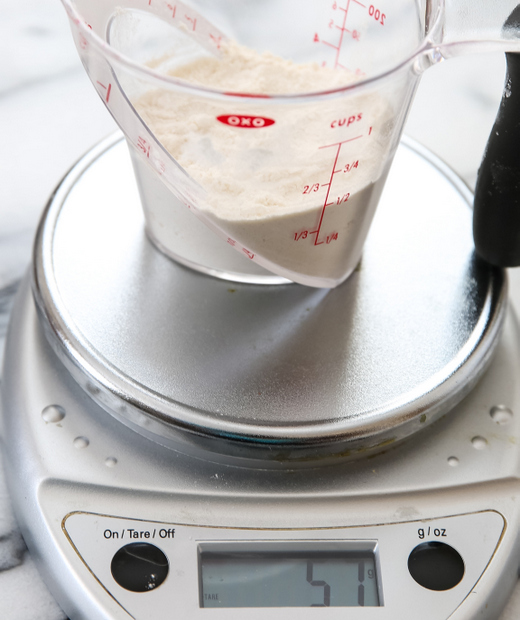
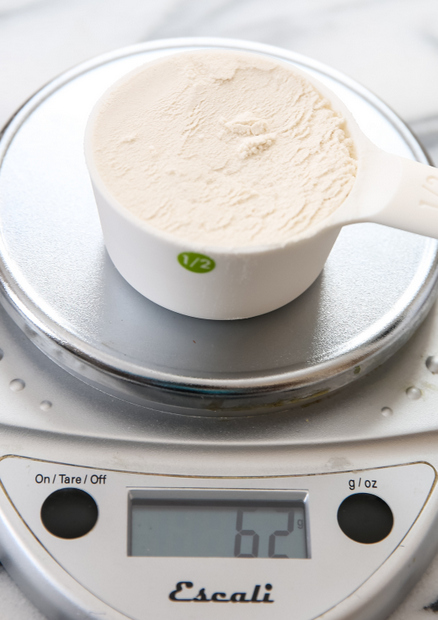
Here, I weighed both out in grams. In the dry measuring cup, 1/2 cup of all purpose flour weighs 62 grams. But when I used the liquid measuring cup, I got 57 grams. That’s 5 grams difference (about 2 teaspoons). 5 grams may not seem a lot, but it can add up. Let’s say you’re making a cake which requires 3 cups of flour. Now you are off by 30 grams, or about 1/4 cup of flour.
Adding too much flour can cause all sorts of problems including making your baked good too dry, dense, change the texture from chewy to cakey, etc. Similarly, adding too little could cause your batter to be too wet, spread too much, not rise properly, etc.
Measuring liquid ingredients
Now, let’s reverse it. What happens when you try to use a dry measuring cup to measure out the liquid ingredient?
Let’s say your recipe calls for 1/2 cup of water.
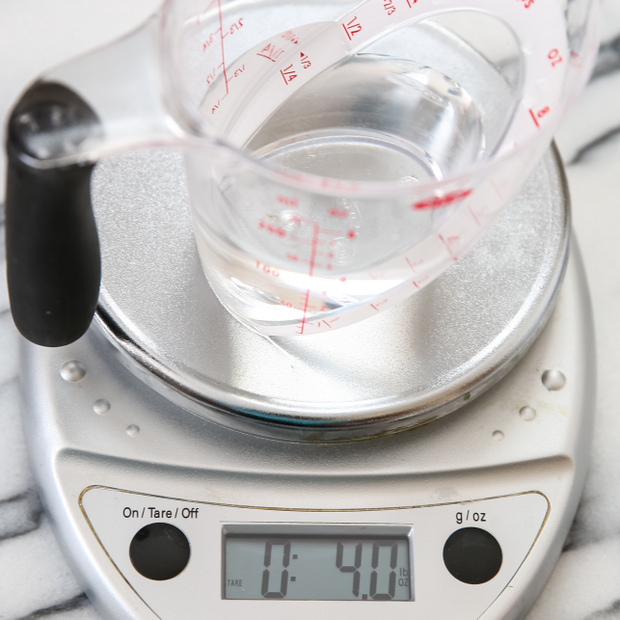
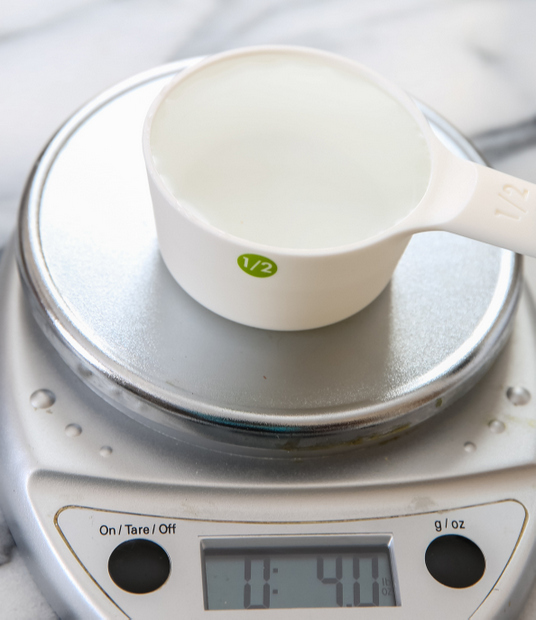
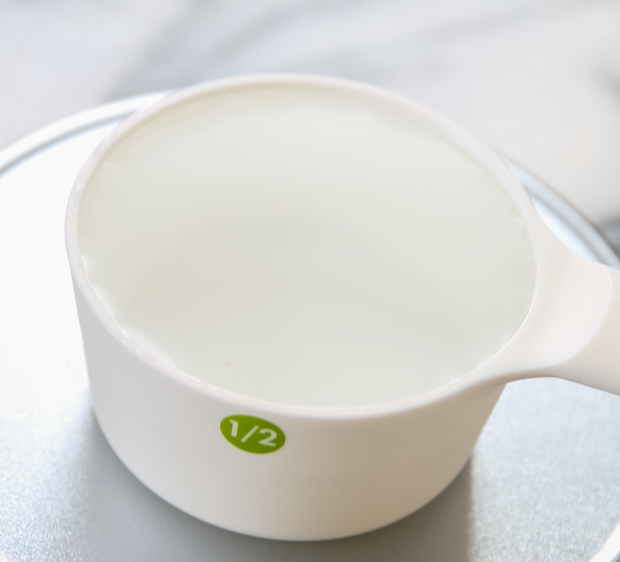
Here, I am trying to measure out 1/2 cup of water, which is 4 oz. I put my measuring cup on the scale and poured in the water until it reached 4 oz. It finally does so when the water has reached all the way to the brim of the cup and is just about to spill over. Yes the measurement works, but it will be quite difficult for you to actually get all that water into your recipe without it spilling over. And if you don’t fill the water all the way to the top, then your recipe will be off.
So, while you can technically get a precise measurement by using a dry measuring cup to measure liquids, it will be quite hard for you to add it your recipe without it spilling over, which is why it’s usually better to measure it in a liquid measuring cup, where all you have to do is measure to the line.
Baking Tools
Hopefully, this tutorial has provided you a little more insight as to the importance of having both kinds of measuring cups when you take on a baking project.
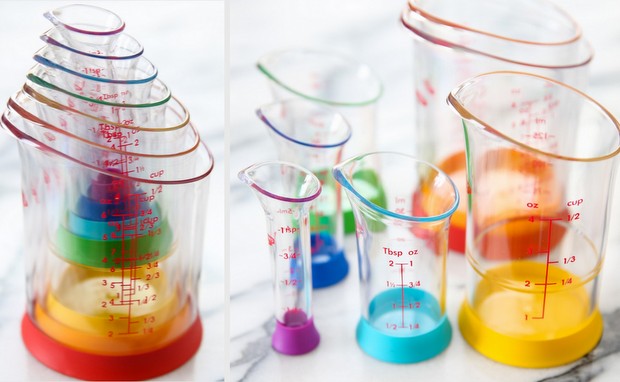
For those curious, I own two kinds of liquid measuring cups: OXO Angled Measuring Cups and OXO Nesting Measuring Beaker Set.
The angled measuring cups work great because you don’t need to be at eye level when you are pouring in your ingredient to read the measurement, as the measurements are written on the top and on the side.
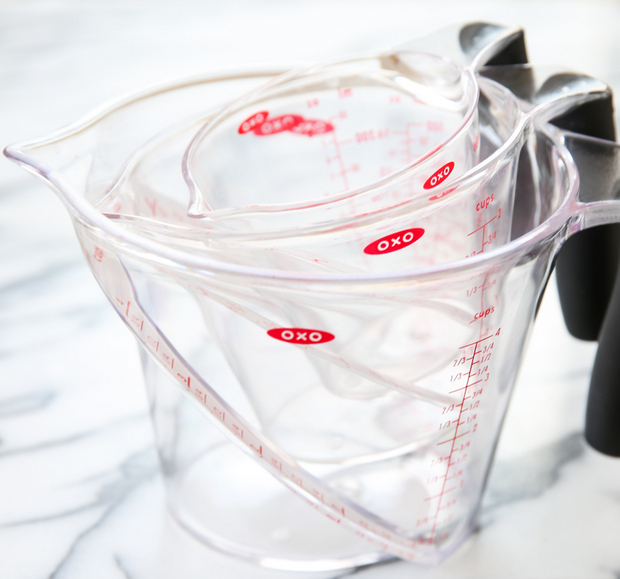
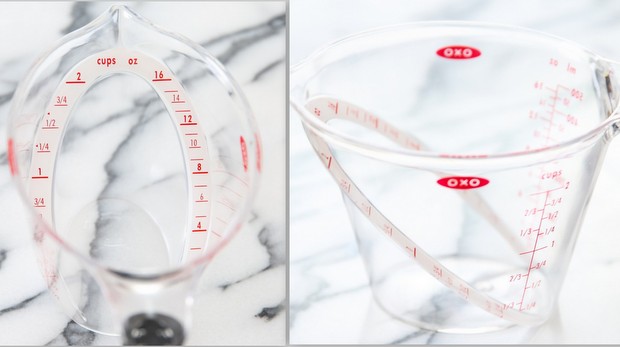
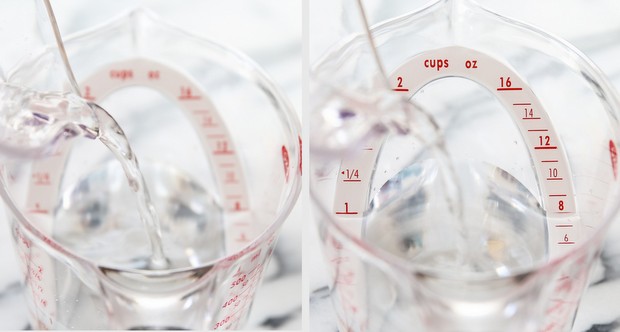
I use the beaker ones for smaller measurements. They even provide tablespoon and teaspoon measurements.
Love this information, will get new meaning tools now. Thank you
Glad it was helpful!
I love those beaker measuring cups. I’ve been eyeing that set for awhile, about time I get it for myself. Excellent post pointing out the differences!
it’s super cute isn’t it? I didn’t even talk about what dry measuring cups I use because I have about 6 sets. I totally don’t need so many, but I buy diff ones cuz they are cute. Not as much selection for the liquid ones though.
What a wonderful, informative article. I’ve been keeping a food diary since July, 2016 and have become very familiar with all of my measuring devices – cups, spoons, and scale. I have the 1c., 2c., & quart size P___x glass cups. I love them.
glad you enjoyed the article!
Such a brilliant post- it’s so crazy how few people know the differences they things make when baking and cooking!
Thanks! it’s easy to forget to explain some of the fundamentals when you’ve been baking/cooking for a long time. I just assume people know, and then realize they don’t always. So hopefully this will help some people!
The more important questions are (since they can actually make even bigger differences):
1) How did you get the flour out of the bag into the measuring cup – directly with the cup or with a spoon (the flour will be differently packed and will have a different weight
2) Did you sift the flour or not ?
i agree how one measures the flour is also something can affect the recipe. how to measure flour and “packing” issues was actually going to be my next tutorial, but I really wanted to break it down to one issue at a time.
Thanks for the tutorial. I bake so I’m aware of the differences in measuring cups, but this is helpful info to those who don’t bake. You forget about these things; once my brother-in-law called to ask me what it meant to cream butter and sugar. He thought he had to use half-n-half!
I must have those beaker measuring cups! I have a 4 cup Pyrex glass measuring cup that I often use as a mixing bowl; the spout makes it easier to pour the contents.
I’m glad you found it helpful! It actually helped me as well to have to lay it all out and explain it. I know a lot of people only own a liquid measuring cup (including my mom), and use that for every measurement! I love my beakers. hehe. I use them a lot when I’m mixing cocktails too.