

Raindrop Cake
This low calorie and popular food trend can be easily made at home with just a few ingredients!
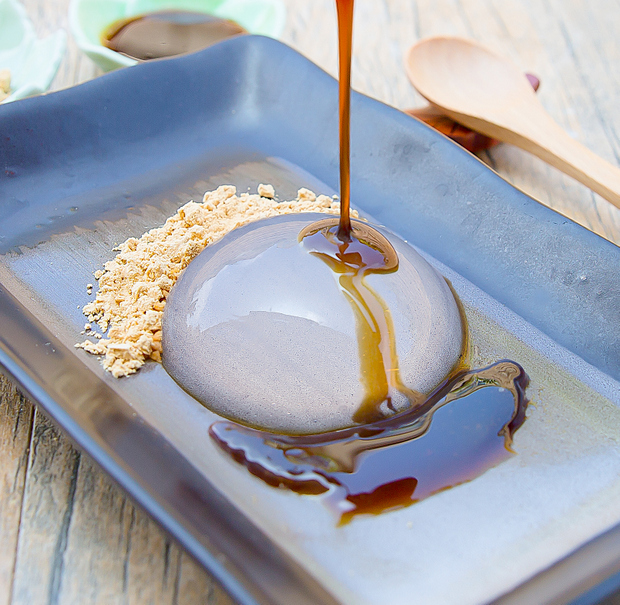
Over the last few months, I’ve been very intrigued by the Raindrop Cake. Inspired by a traditional Japanese dessert, Mizu Shingen Mochi, the dessert was introduced to the US by Chef Darren Wong at Smorgasburg in New York. Since then, the unique looking dessert has become very popular.

The name Raindrop Cake comes from its appearance– which looks like a giant raindrop– as well as the taste. When you bite in, the dessert dissolves in your mouth, like eating rain. The dessert is very delicate and is supposed to only hold its form for about 30 minutes.
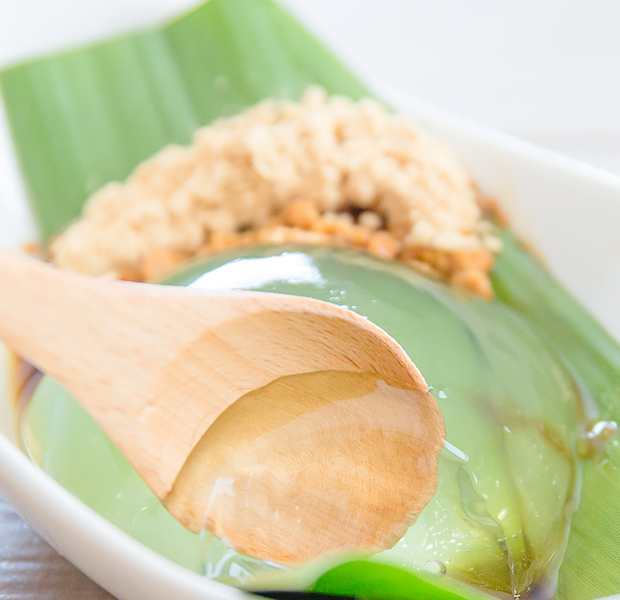
The raindrop itself is made out of only two ingredients: water and agar. By itself, the cake is fairly tasteless. But it’s paired with roasted soy bean flour (kinako) and black sugar syrup (kuromitsu), which add sweetness and texture. The end result is a surprisingly refreshing dish which I really enjoyed. The dessert is apparently also very popular in Japan because the raindrop itself is almost zero calories. (Even with the toppings, you’re looking at around 50 calories per serving.)
Even though the raindrop cake is only two ingredients, it actually took me several trials before getting the right proportions. Before attempting to make it, I did a lot of research. I’m documenting my findings here, so that hopefully you won’t have to go through the same trial and errors and can have success on the first try.
Agar. Agar is a a gelatin-like substance that is derived from algae. It is commonly used in Asian desserts, especially any that have a jelly consistency. Normally, agar-based desserts have a somewhat firmer, jelly texture. However, based on all the descriptions I read about the raindrop cake, it’s supposed to be very delicate and only hold its form for about 30 minutes before dissolving.
When I started reading through recipes, I found big discrepancies in the amount of agar used. Some recipes called for a few grams (which is the equivalent to a few teaspoons) and some called for barely 1/8 of a teaspoon. When I used a larger amount of agar, the mixture was cloudy and the end result was very firm. It would set within an hour and it did not dissolve in my mouth. I’m still puzzled by how the recipes work with the large amounts of agar, but I do have one theory. I think that the recipes that call for the larger amounts of agar are using a special agar, even though the recipes just say “agar powder.” I noticed a few videos talk about using a Japanese-style agar or a Cool Agar. I’ve never worked with either, but just the name Cool Agar makes me think it’s an agar that would keep the crystal clear appearance and not turn cloudy like regular agar powder does. I also think that the Japanese version may be firmer than the one introduced in the US. When I was looking at the videos, the cakes didn’t seem to be quite as delicate.
When I used a very small amount of agar, the water did just barely turn into a cake. At first, I tried 1/8 tsp. This was enough to allow the cakes to set, but they were a little too delicate. When I tried to take them out of the molds, they broke in half. So I played around with it, increasing a little more agar at a time, until I found the right balance. I was surprised by how much of a difference a tiny bit of agar could make. For instance, adding just one more 1/8 tsp was enough to make the cake look more opaque than translucent.
Water. The original recipe calls for mineral water. I tried it both with mineral water and filtered water and didn’t really notice much of a difference. Since we don’t usually have mineral water in the house, I’m just going to stick to filtered water from now on.
These are the basic ingredients you need:

The agar powder can be found at most Asian supermarkets. Make sure you buy one that is pure agar powder. The two toppings (roasted soybean flour and black/brown sugar syrup) can easily be found at a Japanese market, though you can also make the syrup yourself. It’s basically a simple syrup made with brown sugar.
To get the shape, I bought this Freshware 6 Cavities Half Circles Silicone Mold. It seemed to be about the right size as the ones I’ve seen in photos and you can make six at a time. They also slide out very easily. You can try using other similar shaped molds, just make sure you use something that allows you to easily remove these because they are delicate and you don’t want to break them. I’ve seen people use the sphere ice ball molds. I actually own those as well, but I wasn’t sure how well they’d turn out in those, so I didn’t try.
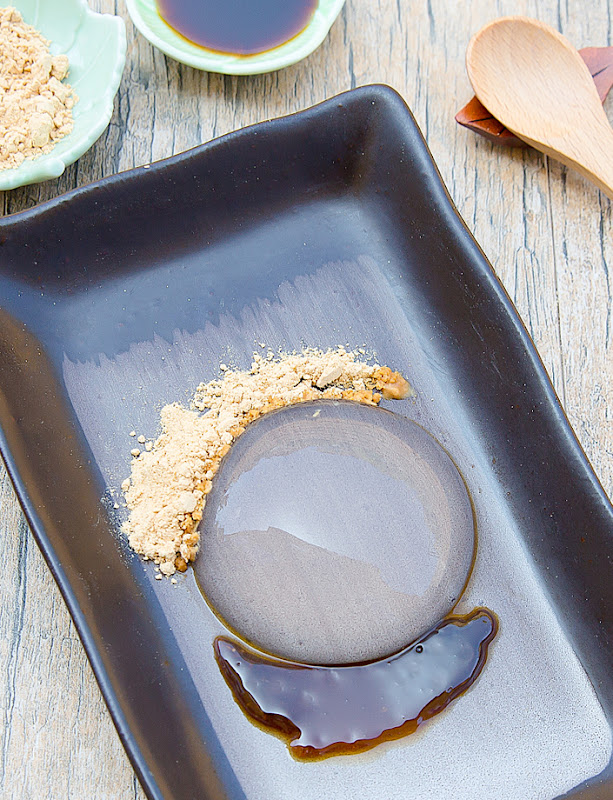
Overall, I actually really enjoyed this dessert. The soybean powder mixed with the black sugar syrup is a delicious combination. When eaten with this water cake, it becomes a very light and refreshing dessert.
Special Tools
Freshware 6 Cavities Half Circles Silicone Mold*
*Some of the links contained in this post are affiliate links. Much like referral codes, this means I earn a small commission if you purchase a product I referred (at no extra charge to you).
Update: Since this post I have experimented with this cake even more and figured out how to make it looks crystal clear, similar to how it is served at cafes. You can check out my cherry blossom version to learn more.
Raindrop Cake
Ingredients
- 3/4 cup water
- 1/8 tsp + 1/16 tsp agar powder
toppings
- 1/2- 1 tbsp roasted soybean flour
- 1-2 tbsp black sugar syup
Instructions
- In a small saucepan, add agar powder and water and stir with a spatula a few times, until the agar powder dissolves into the water.
- Turn your stovetop to medium heat and bring the agar water mixture to a boil. Maintaining a medium heat level, allow mixture to boil (without a lid) for one minute, then turn off heat. Try to be as accurate with the timing as possible. If you don't heat long enough, your agar won't be fully dissolved. If you cook too long, your mixture will condense down too much. Use a spatula to stir the mixture a few times. Pour mixture into molds. You should have enough to fill exactly two cavities if you are using the silicone molds I used.
- Place molds into the fridge to set. I recommend letting them set overnight, or at least 10 hours. When they are ready, they should easily slide out just by you slightly tilting the molds. Do not take the cakes out of the fridge until you are ready to serve because they will start to melt after 20-30 minutes. Add your cakes to a plate. Add some soybean flour to your plate and drizzle black sugar syrup on top of the cake or on the side.
Notes
- 1 cake is about 30-50 calories, depending on how much of the toppings you add.
- Since this post I have experimented with this cake even more and figured out how to make it looks crystal clear, similar to how it is served at cafes. You can check out my cherry blossom version to learn more.
what happens if it sits for too long?
As mentioned in the recipe card, after about 20 to 30 minutes the cake will start to melt.
I tried this recipe several times already. At first, the recipe worked perfectly find, but now that I’ve done it a couple of times, my cakes don’t seem to be setting as well as the first or second time. Maybe this is because I rushed, but I’m pretty sure I didn’t do anything different. Is there anything I can do to fix this? I really love the outcome of the first ones, but it seems more and more impossible to make the cakes set perfectly each time I try.
It’s hard to know what the issue might be – weather conditions/kitchen temperatures can definitely affect things. It could also be the agar you are using. Did you switch brands? There are some out there that aren’t as great or aren’t using pure agar which could also be the issue.
I just tried this and it succeeded so totally recommend this recipe! Although I put in exactly the correct measurements, mine set after just 2-3 hours. I don’t know if this is because of something else, but when I took it out, it looked a bit unclear. It was perfectly clear, but when I put in something, you could notice some weird shapes. If this is usual, then nevermind. Still very tasty and a super good recipe.
We’re so glad you loved the recipe! The agar powder makes a difference with how clear the raindrop cake is. If you use agar powder that’s readily available in the US, the cake won’t be as clear. There is a type called cool agar that is used in Japan. Kirbie discusses this more in her post about Cherry Blossom Raindrop Cake – it makes a raindrop cake that is crystal clear. Hope that helps!
Hi there! My daughter is requesting raindrop cake for her birthday cake this year and I wanted to make a large batch… maybe 10? Is it recommended to multiply this recipe that big? I see the serving size is 2… is that for two cakes or one?
The recipe makes two raindrop cakes. We haven’t tried scaling the recipe to make more cakes. The measurements need to be very precise and without testing it we can’t say how it will work.
This was an amazing cake . I really did not expect it to work , but it did.
We’re so happy to hear that!
Does it need a certain type of mold or can I just Use a bowl
We recommend using the silicone mold that is discussed in the post.
I made this recipe last night at around 9. This morning when I checked on it at 10, it was still like water. Even now it still is like water. I used agar agar flakes by the brand Eden I’m not sure why it didn’t work. I will try it again with 1/4 of a teaspoon
the recipe calls for agar powder. Agar flakes is not the same thing and you need a lot more agar flakes to equal the powder. that is why yours is not setting.
Hi,
Excited to make this! Wondering though, does it have to come to a rolling boil, or just start bubbling? Just wondering when to start that 1 minute countdown. My electric stove takes a while to heat up so feel like it’s been while since it’s been a little bubbly on the bottom of the pan but nothing else seems to be happening…i’m worried that this is it and if i keep letting it go for too long it’ll be overdone?
Thanks!
It needs to start boiling.
Great recipe! I actually added a tablespoon of sugar to the mix with slightly more agar and water to give the cake a bit more flavour. I also used honey as a substitute for the brown sugar syrup and it was all still delicious. My ratio might of been off, but, the chilled cakes did stick to the mold a bit and didn’t come out perfectly smooth. But, overall, this was a great and simple recipe that I will certainly be trying again.
adding the sugar likely made them stick more too, but I’m glad it worked out for you
Whenever I make these, they stick to the mold and fall apart when I take them out. Any tricks to getting them not to stick? Using a silicone mold.
I haven’t had any issues with them sticking before. You may want to play around with the amount of agar you are adding. You may need to add a little more to firm them up more so they are easier to remove.
must the mixture cool before we pour into molds?
No. You pour it in right away
Can I sub agar powder to gelatine powder?
We’ve only used agar powder – if you use gelatin the amount will need to be adjusted and you may not get the same results.
Thanks for the detailed instructions. I finally tried this. I got a clearer “cake” with mineral water and the same brand of powder you used. I first used strands of agar and filtered water, but the cake was noticeably cloudier. The numerous tips really helped. We wanted to eat it almost as soon as it set, but leaving it overnight allowed it to stay a bit firmer longer. Thanks again.
I’m glad my tips helped! The clearest version of this cake uses cooling agar but I have only found that produce in Japan.
I tried your recipe and it worked! My kids love it. Thank you so much for sharing the recipe.
I’m so happy your kids loved it!
I’ve just seen these and am interested in trying the recipe. Seems like it takes a few tries to get the proportions right. I can’t tell if the cake in the first picture is more cloudy bc of the slightly blue dish. The second picture with the bamboo spoon is almost see thru. Is this the one with mineral water?
Also, if I buy that mold, can I just triple the recipe without any problems to make 6?
Thanks so much. This seems like a fun thing to eat.
the two were made exactly the same, just using different plates and lighting. The biggest difference for clarity is the agar powder. There is something called cool agar, which is what a lot of restaurants use to achieve the crystal clear appearance. But that is difficult to find depending where you live. The more commonly sold agar powder works but the appearance won’t be as see-through. It still looks impressive though! You can double or triple the recipe with no issue.
I’m wanting to add dragon fruit to mine. At what point would you recommend adding it to the mould ?
Here is a version I did with fruit: https://kirbiecravings.com/strawberry-raindrop-cake/
Can you unmold these and keep them refrigerated for a Couple days or will they still fall apart
I recommend no more than one day. They start to shrink and disintegrate when kept in the fridge too long
omg never heard of this but it looks stunning! if I get ambitious, i’ll find this agar powder and use your proven method =P
agar agar powder is pretty easy to find. The one I used can be found at most Asian supermarkets. I got mine at Ranch 99
that is so mouth watering. when I saw the photo, I am sure my kids will totally love it. Will it be ok to add gelatin powder into that?
I do not know if it works with gelatin powder
This looks so interesting and beautiful!
I really love the transparent appearance
It’s amazing that you can get a cake out of this proportion of water and agar powder!. I’m not sure if I want to buy the silicone mold so I might try this using silicone cupcake liners.
I’ve also seen videos where they poured it into glasses that had round bottoms, but those were the japanese version so I’m not sure how easy they are to slide out with just regular glass.
You can also use rice bowls! Just be careful how you remove the cake
This looks intriguing, I like how you presented the dessert in a dome shape with the kinako and kuromitsu on either side. I will definitely try this! Thanks!
I hope you like it! It’s definitely unique and interesting